
Reverse Center - The Recovery Geometry That Keeps Grid Systems Alive
Why Most Grid Systems Fail at the Center
Most grid traders focus on spacing, lot sizing, and how many levels they can place before margin runs out. Very few understand that the most dangerous zone of any grid system is not the edges — it is the center. The center of the grid is where exposure geometry begins, where recovery logic is anchored, and where directional bias is silently created. A poorly engineered center turns even well-spaced grids into long-term failures, while a correctly engineered center dramatically increases survivability, recovery probability, and profit stability.
In classical grid models, the center is treated as neutral. The system begins by placing symmetric buy and sell orders around the current price, assuming that oscillation will naturally balance the system. This assumption is mathematically incomplete. Real markets are not symmetrical oscillators. They expand directionally, compress asymmetrically, and retrace in uneven waves. If the center is left neutral, the first layers of exposure immediately begin accumulating loss during directional expansion without any directional hedge to slow down the growth of floating drawdown. This creates an invisible vulnerability that only becomes visible when the grid is already deep.
Reverse Center exists to solve this structural weakness.
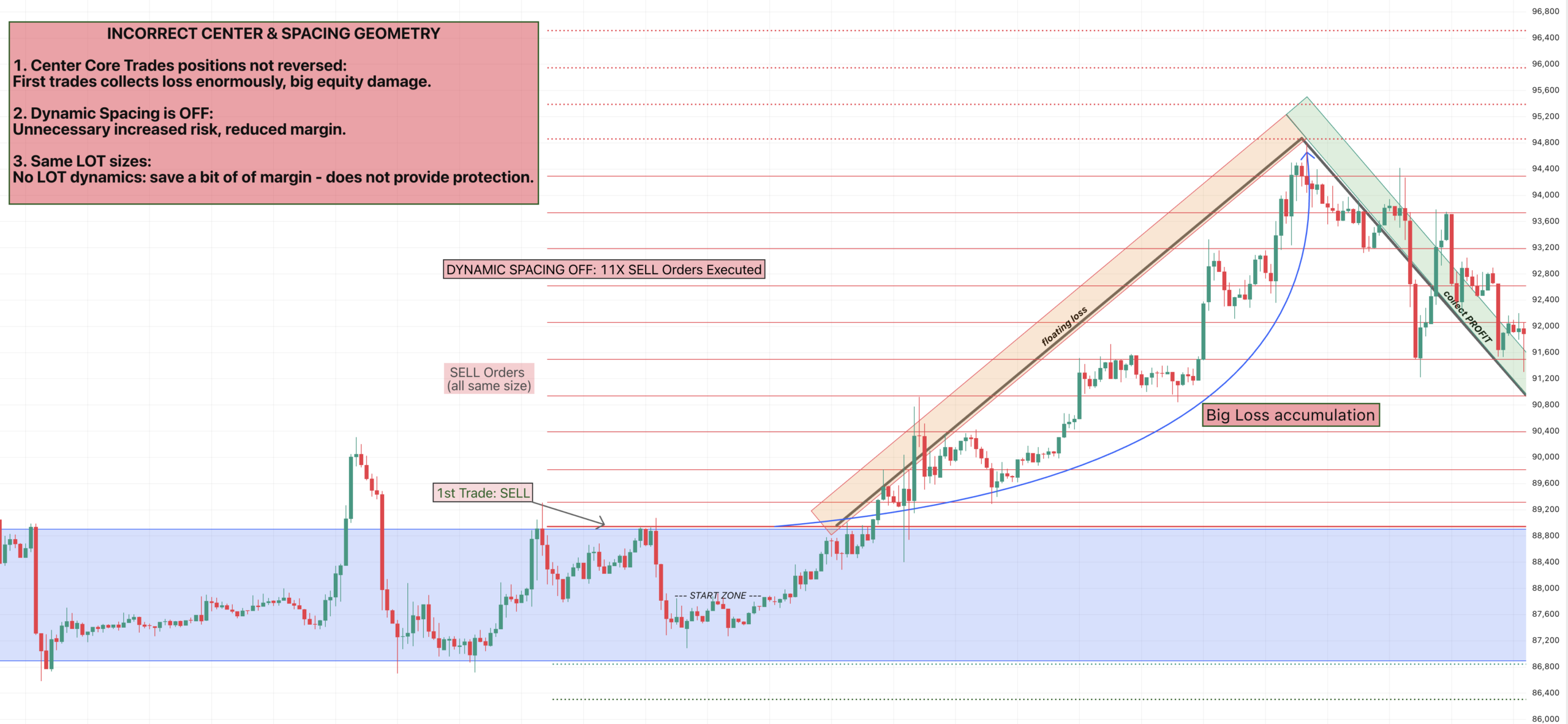
What Reverse Center Actually Does
Reverse Center is a geometric correction layer that intentionally biases the first center orders in the opposite direction of grid expansion. Instead of placing a purely neutral symmetric grid, Reverse Center introduces two strategically inverted core positions that create directional compensation during expansion phases.
In simple terms:
If price expands upward, the first center order generate profit
If price expands downward, the first center order generate profit
This profit acts as an active hedge against the growing floating loss of the expanding grid
These center trades are not random. They are mathematically positioned to travel the furthest distance during grid expansion, which means they become the strongest compensating profit anchors in the entire system.
Reverse Center transforms the grid from a purely reactive structure into a self-balancing recovery engine.
Why the First Center Trades Are the Most Important
The first center trades are geometrically unique. They are:
The earliest entries
The furthest traveling positions
The deepest eventual profit carriers
The last to be closed during basket equilibrium
When price expands, these positions move the furthest. This means that any profit they generate scales faster than any other trade in the grid. By reversing them, the system injects a profit gradient that increases with expansion depth – exactly when drawdown pressure is rising fastest.
This creates a built-in recovery accelerator.
Without Reverse Center:
Floating loss grows with every expansion step
No internal profit is created to offset this growth
The grid relies entirely on retracement to recover
With Reverse Center:
Profit is generated during expansion
Margin buffers decline more slowly
Basket equilibrium shifts closer
Retracement requirements become smaller
This single geometric modification dramatically increases grid solvability.
The Mathematics of Center Compensation
Consider a grid with spacing Δ and lot size L.
Let price expand n steps upward.
Without Reverse Center, total floating loss grows approximately as:
Σ (i × Δ × L), i = 1 to n
This grows quadratically as depth increases.
With Reverse Center, two inverted core trades generate profit:
Profit ≈ 2 × n × Δ × L
This profit term reduces the effective growth curvature of floating loss.
In effect, Reverse Center reshapes the drawdown curve from a pure quadratic expansion into a compensated curve with partial linear offset. This reduces the retracement distance required to return to basket equilibrium.
In simple terms:
The deeper price goes, the more your center hedge works for you.
What This Means in Real Trading
Imagine price moving upward for a prolonged period. Without Reverse Center, every sell order is losing, and nothing inside the grid is producing profit until retracement begins. Margin is being eaten continuously. Even if retracement comes, it may be too late.
With Reverse Center:
The first center buy trade are producing profit during the expansion
This profit offsets part of the growing floating loss
The account survives deeper movement
Required retracement depth becomes smaller
Instead of being passive, the grid becomes self-supporting during expansion.
Why Most Public Grid Bots Don’t Use It
Reverse Center is rarely implemented because:
It complicates recovery math
It requires dynamic basket equilibrium recalculation
It cannot be implemented with simple template logic
It requires real exposure geometry modeling
Most grid bots are built as spacing-only engines. They collapse silently when expansion exceeds solvable depth.
Reverse Center turns a grid into a recovery engine — not just an order generator.
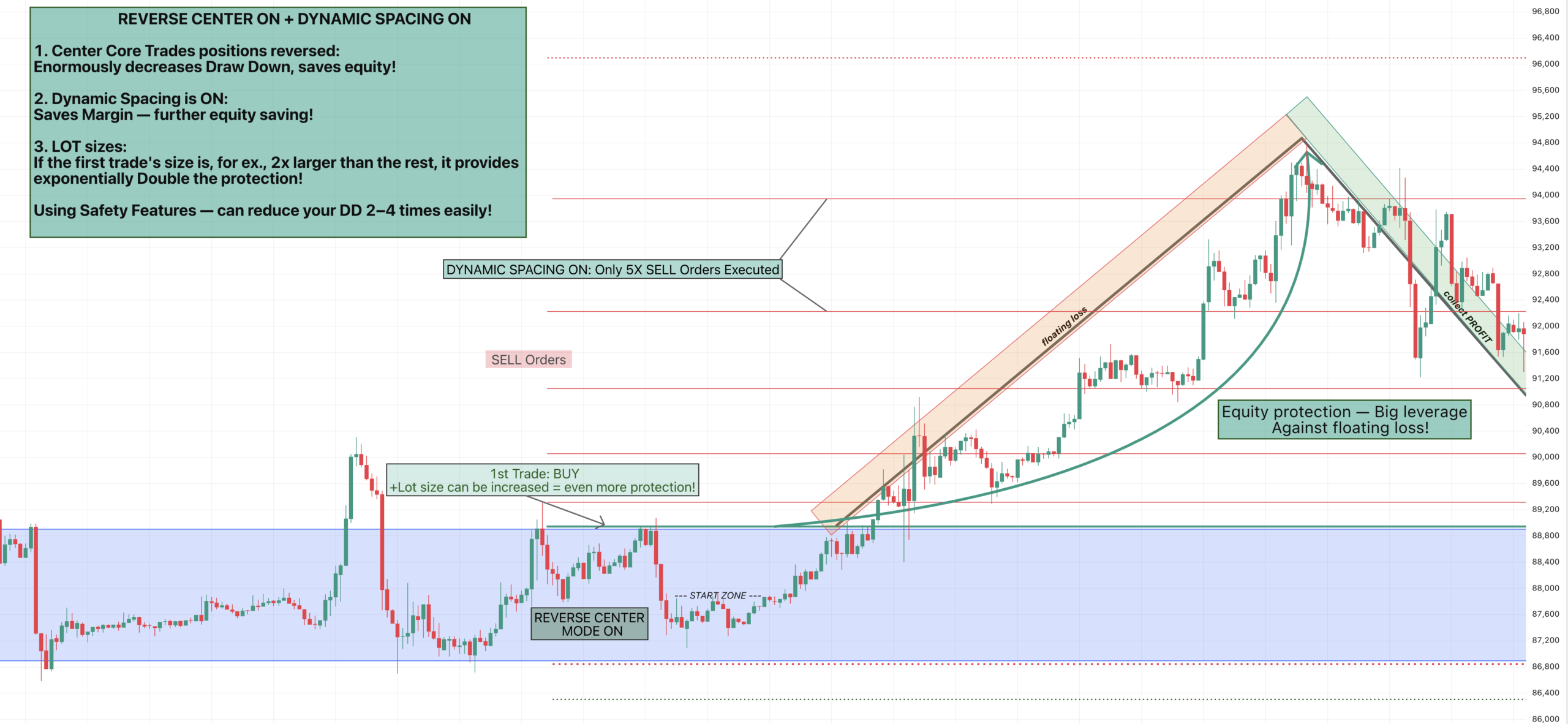
Reverse Center as a Margin-Stabilizing Geometry Layer
Once dynamic spacing controls the horizontal density of a grid, Reverse Center controls its vertical solvability. Where spacing defines how fast exposure grows, Reverse Center defines how fast recovery capacity grows. These two together determine whether a grid remains mathematically solvable under prolonged expansion or slowly crosses into an unrecoverable exposure state.
In a classical grid without Reverse Center, margin drawdown follows a pure convex curve. Each additional filled order increases not only total floating loss, but also the speed at which margin is consumed. This means the system becomes increasingly fragile with every step of expansion. Reverse Center reshapes this curve. It injects a counter-gradient that actively flattens drawdown curvature. Instead of drawdown accelerating uncontrollably, its growth rate becomes partially self-damped.
In practical terms, Reverse Center does not simply “reduce drawdown.” It changes the mathematical slope of drawdown growth. This is far more important. The grid becomes progressively harder to break as it goes deeper — the opposite behavior of classical grids.
This is why Reverse Center grids often feel paradoxical: the deeper price goes, the calmer the system becomes.
Interaction Between Reverse Center and Dynamic Spacing
Dynamic spacing slows exposure growth horizontally. Reverse Center slows drawdown growth vertically. Together they form a two-dimensional recovery geometry.
Dynamic spacing ensures that additional orders are placed further apart as expansion continues. Reverse Center ensures that profit generation increases with expansion depth. The deeper the grid, the wider its spacing becomes and the stronger its internal profit hedge becomes. These two forces reshape grid behavior from fragile ladder stacking into a stabilizing recovery engine.
Instead of depending entirely on retracement probability, the grid begins to generate its own internal recovery power. This is what allows advanced grids to remain operational even inside trending markets — not because they “predict trend,” but because their exposure geometry no longer collapses under directional pressure.
Why Reverse Center Enables Trending-Market Survival
In trending markets, classical grids die because drawdown grows faster than retracement can recover. Reverse Center alters this relationship. By injecting expansion-side profit into the exposure field, the grid reduces the retracement depth required to close baskets profitably. Trend becomes less of a threat and more of a recovery accelerator.
This is why Reverse Center grids are capable of operating in:
Persistent directional markets
High-momentum indices
Strong metal and crypto expansions
Long unidirectional currency legs
Instead of waiting passively for retracement, the system actively builds internal compensation while price is moving away.
The Psychological Layer – Why Traders Misjudge Reverse Center
From a human perspective, Reverse Center looks counter-intuitive. Traders instinctively fear adding positions “against the move,” and they fear reversing trades at the grid center. But grid mathematics does not operate on directional bias – it operates on exposure geometry and retracement probability.
Reverse Center appears aggressive. In reality, it is mathematically conservative. It reduces required retracement distance, flattens drawdown slope, preserves margin buffers and shortens recovery cycles. It converts directional pressure into recovery fuel.
What feels dangerous to intuition is what actually stabilizes the system.
What Happens Without Reverse Center
Without Reverse Center, even well-spaced grids slowly drift toward structural insolvency. They may remain profitable for months while silently crossing into an unsolvable geometry zone. When extension exceeds the grid’s recovery envelope, no amount of retracement can mathematically close the basket safely.
This is why most public grid bots eventually fail – not from bad luck, but from invisible geometric erosion.
The Exponential Safety Amplifier: Center Lot Geometry (our secret-special no one teaches!)
Reverse Center already creates a powerful geometric safety anchor inside the grid, but its protective effect can be amplified even further through one additional structural parameter: center lot geometry.
The two central anchor trades are not just directional “guards.” They are the deepest geometric leverage points inside the entire grid structure. Every retracement profit cycle, every basket equilibrium calculation, and every floating loss neutralization wave ultimately references these center anchors. This means that their lot size does not scale linearly – it scales structurally.
By increasing the lot size of only the two center anchor trades (for example, 1.5×, 2×, or dynamically adjusted), the grid’s internal solvability geometry changes exponentially:
• The break-even equilibrium shifts closer
• Required retracement depth decreases
• Floating loss curvature flattens
• Basket recovery speed increases
• Drawdown compression efficiency rises
This creates a powerful mathematical effect: the grid requires less price movement to neutralize more accumulated exposure.
In simplified terms, instead of forcing the market to retrace a long distance to recover many small layered positions, the grid now has two deep anchor trades that generate disproportionate recovery force. These anchors “pull” the entire exposure field back toward equilibrium faster, reducing the amount of retracement needed and dramatically lowering the probability of runaway expansion.
Mathematically, if normal grid recovery requires:
Recovery Distance ∝ Σ(|Price − Entryᵢ| × Lotᵢ)
then increasing only the central Lotᶜ shifts the entire summation geometry so that:
Required Recovery Distance ↓
while
Total Recoverable Profit per Unit of Retracement ↑
This is why center lot geometry does not increase risk – it reduces recovery requirements.
In real trading terms, this means:
• Deep expansions recover faster
• Smaller retracements become sufficient
• Margin stress compresses earlier
• Equity curves stabilize sooner
• Structural collapse thresholds move far away
Instead of making the grid heavier, center lot geometry makes it stronger at its core.
This mechanism is fully implemented in Grid EA PRO through the Center Lot Size parameter, allowing traders to mathematically tune recovery curvature and solvability depth according to account size, volatility profile, and desired stability envelope.
It is a subtle parameter and one of the most misunderstood – yet it is one of the most powerful safety multipliers in grid engineering.
Reverse Center creates the anchor.
Center lot geometry gives that anchor mass.
And together, they form one of the strongest recovery geometries ever engineered into grid systems.
Final Thoughts
The Hidden Truth of Reverse Center
Reverse Center is not an “option.”
It is not an “aggressive mode.”
It is not a stylistic preference.
It is a structural solvability correction.
It defines whether a grid is a fragile frequency trap, or a self-balancing probabilistic engine.
And once spacing geometry and Reverse Center geometry are both correctly engineered, the grid stops behaving like a strategy and starts behaving like a controlled market machine.
That is the point where grid trading stops being speculation – and becomes applied market physics.
Dynamic spacing is one of the hidden engineering layers that separates stable grid engines from disposable template bots.
It transforms grid trading from:
A fragile frequency game into
A controlled probabilistic profit engine
It remains solvable not only during calm markets – but during the very expansions that destroy most grids. And this is only one layer of grid geometry. Spacing protects exposure growth. Reverse Center(another safety feature) protects recovery geometry. When spacing alone is no longer enough, Reverse Center is what quietly saves accounts. That’s where the real magic lives.
Looking for a Reliable Automated Grid EA System?
All of the geometric mechanisms described in this article – dynamic spacing, exposure curvature control, retracement solvability preservation, capital buffer geometry, and progressive risk expansion – are not theoretical concepts. They are already fully implemented and operating inside Grid EA PRO.
Grid EA PRO is a mathematically engineered grid trading system that has been developed, tested, and refined over many years specifically to operate inside solvable volatility envelopes rather than chasing short-term trade frequency. Its internal logic continuously manages spacing expansion, floating loss curvature, retracement efficiency, margin buffers, and basket equilibrium in real time, forming a self-balancing probabilistic trading engine.
Instead of reacting to indicators or attempting to predict market direction, the system is built around structural market geometry – allowing it to adapt dynamically to price expansion, contraction, and retracement behavior.
If you are looking for a reliable long-term automated grid trading system based on mathematical solvability rather than directional guessing, you can review the full Grid EA PRO documentation and user manual here:
https://fxsharerobots.com/grid-ea/
It may be the final trading tool you were actually looking for – not because it predicts markets, but because it is engineered around how markets actually move.
👇 Read More! Important and Interesting Articles About Grid Trading Engineering:
Grid Trading System – Complete Grid Trading Guide
Grid Spacing Geometry – The Real Risk Control in Grid Trading
Why TIME Is the Real Power Source of Grid Trading
Why Most Grid EAs Blow Accounts – The Hidden Mathematics of Exposure Collapse
Grid Trading Money Management – Why Cycles, Not Trades, Are the Real Profit Unit (VERY IMPORTANT!)