
Grid Spacing Geometry – The Real Risk Control in Grid Trading
Grid spacing geometry is the single most misunderstood and most dangerous parameter in grid trading. It is commonly treated as a simple “distance between orders,” while in reality it defines the entire exposure physics of the system – how fast floating loss grows, how margin is consumed, how retracement efficiency evolves, and ultimately whether the grid remains mathematically recoverable under expansion. Most grid failures are not caused by “bad markets,” but by incorrect spacing geometry silently breaking the solvable envelope long before collapse becomes visible. In this chapter we will dissect spacing as a geometric risk control mechanism, explain how exposure density behaves mathematically, why static grids fail, how dynamic spacing reshapes recovery probability, and why spacing is the true stabilizer of grid survival rather than a performance tuning knob.
Spacing Is Not Distance – It Is Exposure Geometry
In grid trading, spacing is not a cosmetic parameter and it is not simply “distance between orders.”
Spacing defines the geometric density of exposure, and density defines how quickly floating loss, margin consumption, and retracement efficiency evolve as price expands. Every grid system operates inside a solvable geometric envelope where profit harvesting and exposure growth must remain in mathematical balance. When spacing is correctly engineered for a symbol’s volatility structure, retracements can neutralize accumulated floating loss faster than exposure expands. When spacing is mis-engineered, exposure grows faster than retracement profit can compensate, creating a silent instability that often appears profitable for weeks or months before collapsing structurally.
This is why spacing is not a performance parameter – it is the primary stabilizer of grid survival.
Grid spacing controls:
How fast open exposure accumulates
How quickly margin buffers are consumed
How deep price can expand before retracement becomes mathematically insufficient
How stable basket closure probability remains under volatility
Profitability can exist temporarily without correct spacing.
Stability cannot.
Volatility Geometry and the Solvable Envelope
Price does not expand in fixed distances. Each symbol has its own volatility geometry – a characteristic way in which it stretches, overshoots, compresses, retraces, and forms correction waves. Spacing must be engineered to match this natural geometry.
Every market has:
Typical expansion leg sizes
Typical retracement depth ratios
Overshoot frequency
Compression behavior
Volatility wave persistence
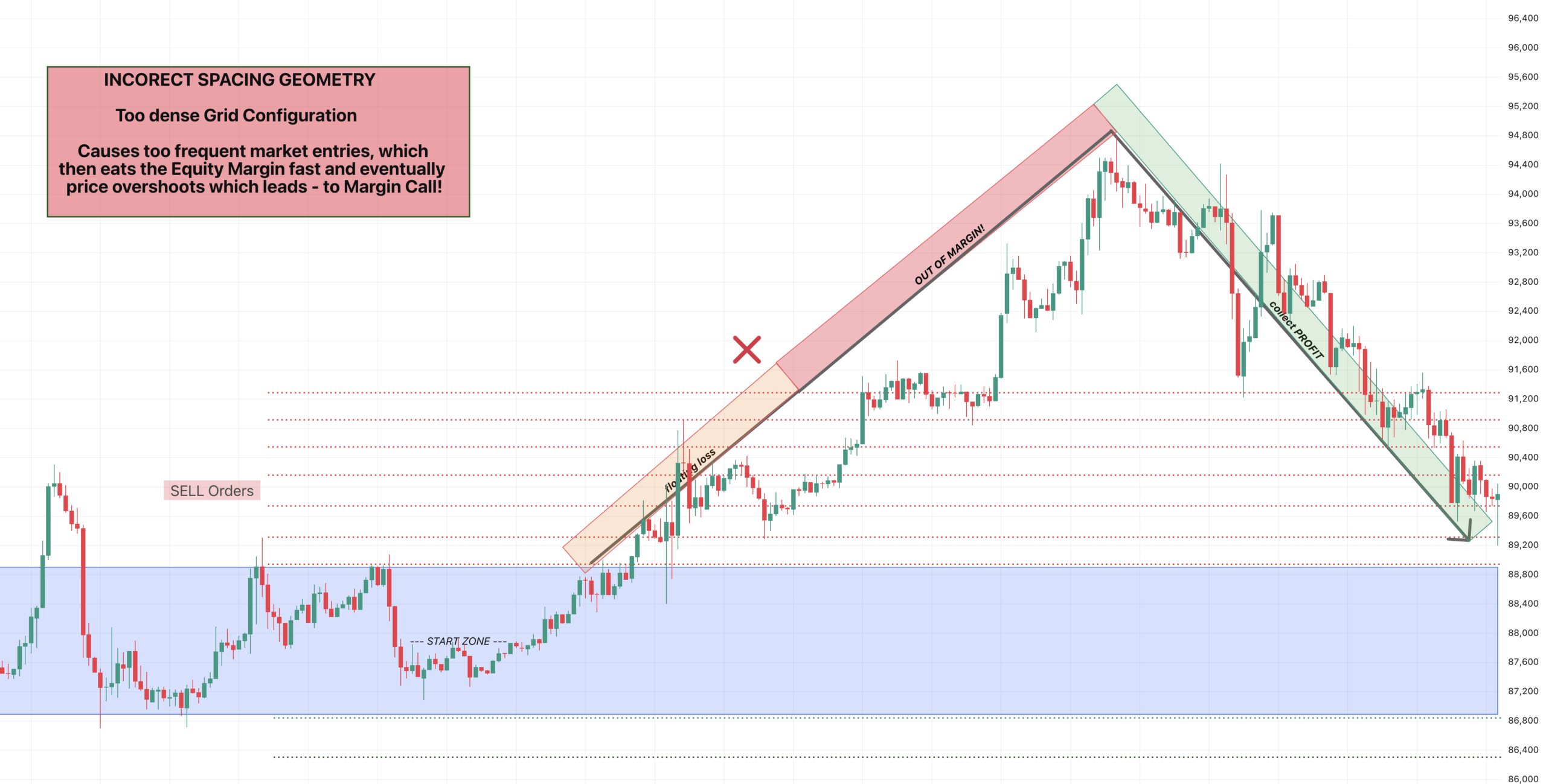
If spacing is tighter than this volatility envelope, order density compresses too quickly. Floating loss grows faster than retracement efficiency can recover it. The grid begins to lose solvability long before collapse becomes visible.
This creates what can be called density collapse – a state where:
Baskets still close
Profits still appear
But exposure geometry is already mathematically broken
And survivable excursion depth has already been exceeded
By the time failure becomes visible, it is already mathematically unavoidable.
The Mathematics Behind Grid Spacing Density
At its core, grid spacing controls the density function of exposure growth.
Every new order does not add linear risk – it adds compounded geometric exposure, because each order contributes both margin usage and floating loss accumulation as price continues expanding.
If spacing is fixed and tight:
Order count grows linearly with price distance
Floating loss grows as the cumulative distance of all open positions
Margin consumption accelerates faster than retracement profit
In simplified form:
Total Floating Loss ≈ Σ |Price – Entryᵢ| × Lotᵢ
As grid depth increases, this summation grows super-linearly while retracement profit grows only linearly.
This is why tight grids may appear profitable for long periods – until a slightly larger expansion suddenly pushes the system beyond its solvable envelope.
Why Tight Grids Collapse Without Warning
In practical terms, every new order increases the entire floating loss surface of the grid.
Ten tightly spaced sell orders during an upward expansion do not create ten equal risks. They create a layered exposure pyramid:
Furthest orders become deeply negative
Middle orders accumulate growing loss
Nearest orders remain shallow but add margin consumption
Entire ladder consumes margin simultaneously
The grid becomes fragile not because the market is “bad,” but because the internal geometry has crossed its solvable boundary.
Common symptoms before collapse:
Increasing basket closure time
Growing retracement depth required to close profitably
Shrinking free margin buffers
Sudden inability to recover after normal volatility legs
The grid still “works” , but it is already mathematically broken.
Dynamic Spacing – Automatic Expansion of the Solvability Envelope
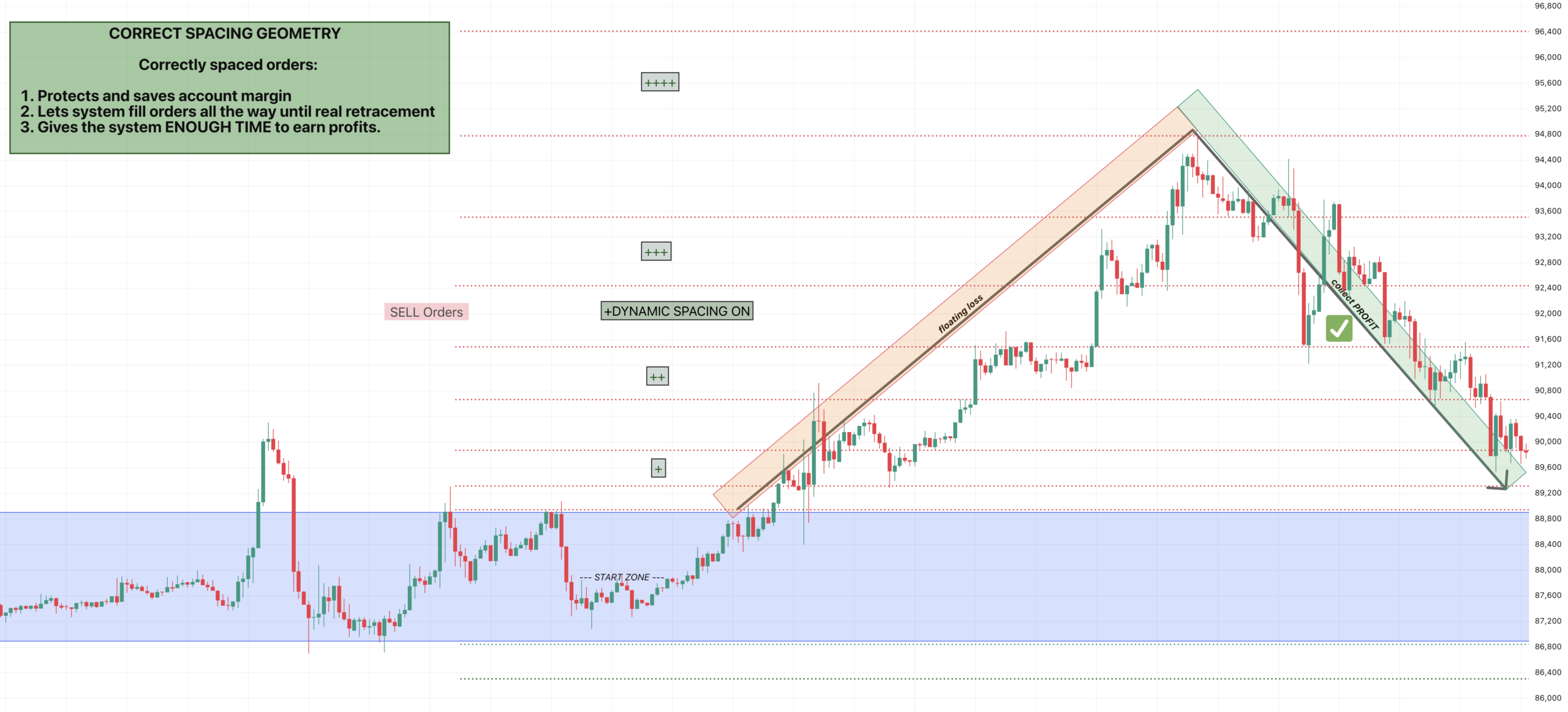
Dynamic spacing is the mechanism that transforms static grid geometry into a self-adapting risk engine. Instead of placing every grid level at a fixed distance, dynamic spacing progressively increases the distance between new orders as grid depth grows. Mathematically, this converts linear exposure growth into a curved expansion profile where each additional order is placed further away than the previous one, slowing down both order density and floating loss curvature exactly when risk accelerates fastest. In simple terms, the deeper price travels, the more space the grid automatically creates for itself to breathe.
In Grid EA PRO this is implemented through the addSpace parameter, which expands the spacing incrementally on every new layer, forming a natural volatility-responsive buffer even when the true excursion behavior of a symbol is not fully known in advance. This geometric expansion:
- spreads margin consumption over larger price distances,
- preserves retracement efficiency,
- dramatically reduces the probability of density collapse during prolonged directional movement.
While dynamic spacing may slightly lengthen individual profit cycles, it massively increases structural survivability, keeping the grid mathematically recoverable even under deep extensions. Instead of becoming more fragile as exposure grows, the grid becomes progressively more resistant — which is exactly how a probabilistic trading engine must behave.
Capital Geometry and Survivable Excursion Depth
Spacing also defines how much capital is required for a grid to remain structurally solvent.
Tight spacing → High frequency → Low survivable depth
Wide spacing → Lower frequency → Much higher survivable depth
There is no universal spacing template.
Each symbol has its own solvable envelope derived from:
Average daily range
Retracement ratios
Expansion persistence
Volatility clustering
Liquidity behavior
Copying spacing templates between symbols silently destroys solvability, which is why grids that appear stable on one market often collapse on another.
Why Automation Is Essential
Dynamic spacing is computationally demanding. The system must constantly recalculate:
Distance expansions
Exposure curvature
Floating loss surfaces
Margin buffers
Retracement solvability
Basket equilibrium levels
Every tick alters the exposure geometry.
A human trader cannot maintain this geometry manually – not because of discipline, but because of mathematics.
Only automation can:
Maintain spacing geometry precisely
Balance floating loss dynamically
Calculate real basket profit in real time
Close dozens of trades at exact equilibrium
Protect the account mathematically – not emotionally
A Grid EA does not simply place trades.
It reshapes the exposure surface continuously to remain solvable.
Final Thoughts
Dynamic spacing is one of the hidden engineering layers that separates stable grid engines from disposable template bots.
It transforms grid trading from:
A fragile frequency game into
A controlled probabilistic profit engine
It remains solvable not only during calm markets – but during the very expansions that destroy most grids. And this is only one layer of grid geometry. Spacing protects exposure growth. Reverse Center(another safety feature) protects recovery geometry. When spacing alone is no longer enough, Reverse Center is what quietly saves accounts. That’s where the real magic lives.
Looking for a reliable automated Grid EA system?
All of the geometric mechanisms described here — dynamic spacing, exposure curvature control, retracement solvability preservation, capital buffer geometry, and progressive risk expansion — are not theoretical concepts. They are already fully implemented and operational inside Grid EA PRO.
Grid EA PRO is a mathematically engineered grid system developed, tested, and refined over many years specifically to operate inside solvable volatility envelopes rather than chasing short-term trade frequency. Its internal logic continuously manages spacing expansion, floating loss curvature, retracement efficiency, margin buffers, and basket equilibrium automatically — forming a self-balancing probabilistic trading engine.
If you are looking for a reliable, long-term automated grid trading system built on structural market geometry rather than indicator guessing, you can review the full Grid EA PRO documentation and user manual here:
https://fxsharerobots.com/grid-ea/
It may be the final trading tool you were actually looking for — not because it predicts markets, but because it mathematically adapts to how markets really move.
👇 Read More! Important and Interesting Articles About Grid Trading Engineering:
Grid Trading System – Complete Grid Trading Guide
Reverse Center – The Recovery Geometry That Keeps Grid Systems Alive
Why TIME Is the Real Power Source of Grid Trading
Why Most Grid EAs Blow Accounts – The Hidden Mathematics of Exposure Collapse
Grid Trading Money Management – Cycles, Common Target PnL, Smart LOT mechanics (VERY IMPORTANT!)