
Why TIME Is the Real Power Source of Grid Trading
Most traders believe grid trading is a price-based strategy. They think its outcome is determined by where the market goes. In reality, grid trading is not powered by direction – it is powered by time. Price is merely the surface variable. Time is the real engine underneath the system, and understanding this changes how grid trading must be designed, funded, and evaluated.
Grid systems do not attempt to win by being correct. They attempt to win by remaining present long enough for statistical inevitability to unfold. Markets are not static. They breathe, compress, expand, retrace, stall, spike, mean-revert, consolidate, and rotate continuously. These oscillations are not anomalies – they are the native state of liquid markets. A grid does not predict which direction price will go. It builds a geometric capture field around price so that every oscillation over time becomes a profit extraction event.
Time is therefore not just “waiting.” Time is the dimension that allows oscillation to complete its cycles. Without time, retracements cannot occur. Without retracements, floating loss cannot be neutralized. Without repeated oscillations, profit cannot be harvested in baskets. This is why grid trading cannot be evaluated on short-term performance. It must be evaluated on solvability over time – the ability of the system to remain alive long enough for the statistical nature of market movement to resolve open exposure back into profit.
Grid trading is mathematically built on recurrence, not prediction. Every grid cycle is essentially a time-dependent recurrence model. Price departs from equilibrium, exposure accumulates, retracement occurs, and equilibrium is restored through basket closure. This loop repeats continuously as long as the system remains solvent. Profit is simply the measurable by-product of repeated recurrence resolution.
In simplified structural terms, grid profit is produced by the number of oscillation cycles completed over time:
Profit ≈ Σ (Retracement Cycleᵢ) – Carrying Cost – Slippage
Price direction does not appear in this model. What matters is how many complete retracement cycles occur while the grid remains alive. This means the grid trader’s primary resource is not precision, it is survivable time.
This reframes risk entirely. In trend trading, risk is “being wrong.” In grid trading, risk is “running out of time.”
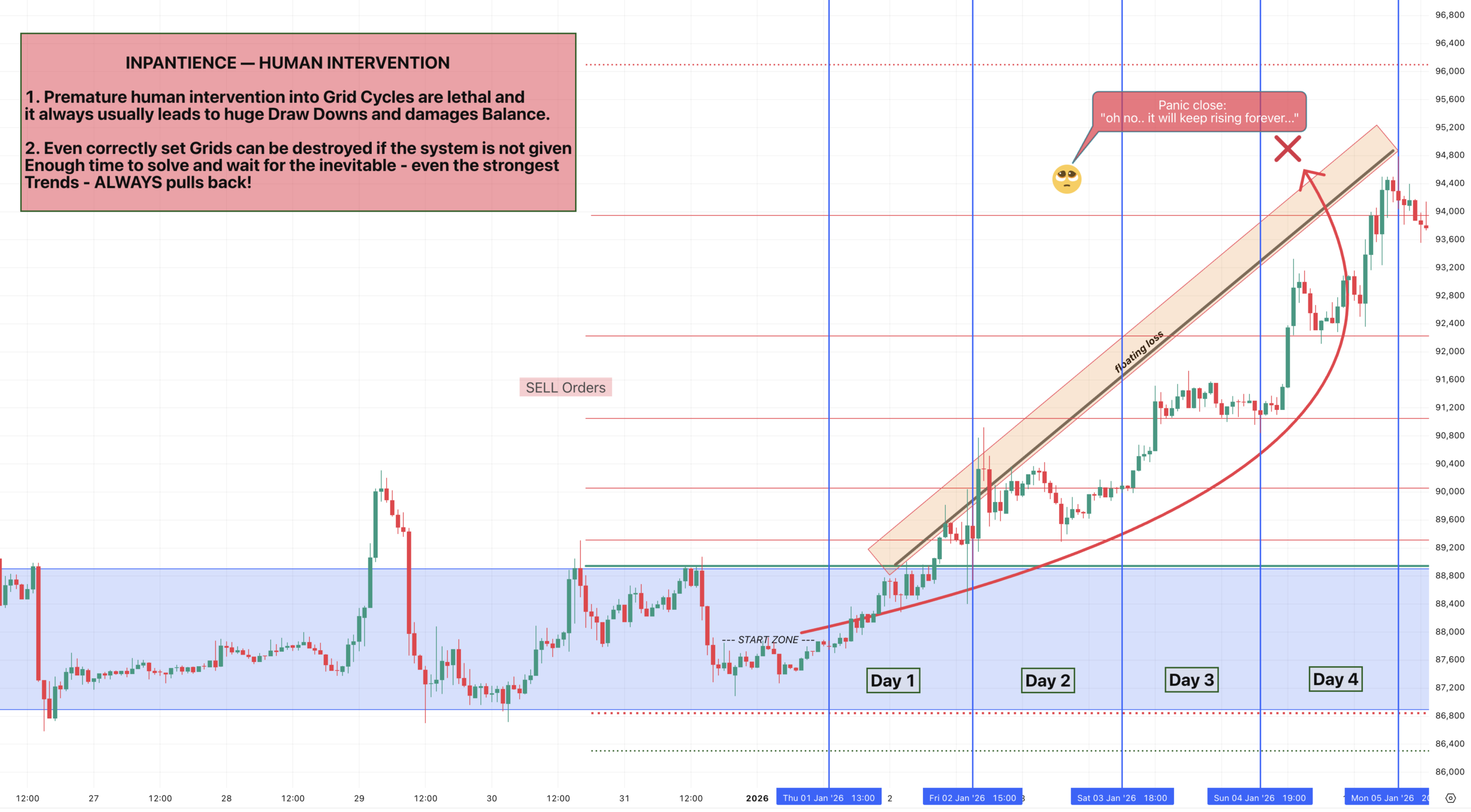
Time as the Solvability Dimension
Every grid system has a solvable envelope — a geometric region inside which its floating loss can always be mathematically neutralized by future retracement. Time is what allows price to return through this envelope and release accumulated exposure back into profit. If the grid collapses before time is allowed to do its work, the system never fails statistically — it fails temporally.
This is the silent killer behind most blown grid accounts. They are not destroyed by the market. They are destroyed by insufficient time allowance — insufficient spacing, insufficient capital buffers, insufficient patience, and insufficient solvable excursion depth.
The grid is not wrong. The envelope is simply too shallow for the time it needs.
Markets can remain imbalanced far longer than human psychology tolerates. Price can trend for days, weeks, sometimes months. This does not break grid logic — it only expands the time window required for retracement to occur. A correctly engineered grid is built to survive these windows. An incorrectly engineered grid collapses before time is allowed to normalize the structure.
This is why grid trading is structurally a patience system, not an aggression system. It does not extract profit from fast price movement. It extracts profit from the inevitability of oscillation over long time horizons.
Why Short-Term Thinking Breaks Grid Systems
Human psychology is optimized for immediate resolution. Grid trading requires delayed resolution. This creates a cognitive mismatch. Traders who do not understand the time geometry of grid systems tend to:
Oversize lots to accelerate profit
Compress spacing to increase trade frequency
Underfund margin buffers
Interfere with baskets prematurely
Abort grids before retracement cycles complete
Each of these actions reduces the available time the grid has to function. They compress the solvable envelope and shorten the recurrence horizon. The grid becomes a short-fused structure that works beautifully during small oscillations but collapses during inevitable larger expansions.
This is why grid trading often appears “profitable until it suddenly dies.” The system was never designed for time – it was designed for speed. And speed kills solvability.
A structurally correct grid is slow. It must be slow. It trades patience for inevitability.
Why Even Strong Trends Cannot Escape Time
Even the strongest trends eventually must retrace. This is not a belief – it is a structural law of liquidity. Trends are not continuous motion systems. They are imbalance discharge processes. Every trend leg is built on liquidity displacement, and liquidity displacement always creates vacuum zones behind it. Those vacuum zones must be re-filled. That refilling process is what retracement actually is. The market is not “correcting” – it is restoring liquidity symmetry.
Grid systems are designed to exploit exactly this inevitability. They do not need to guess where price is going. They only need price to eventually revisit the liquidity zones it already left behind — and that always happens. The only unknown variable is time.
Price can move very far before retracing. But the further it moves, the larger the liquidity vacuum becomes. And the larger the vacuum, the stronger the eventual pullback pressure becomes. This creates a self-stabilizing property in markets: long expansions statistically increase the probability and magnitude of retracements.
Grid systems do not fear this expansion. They prepare for it. They store exposure inside a geometric envelope so that when time finally allows the market to discharge its imbalance, the entire grid unwinds in a single profit resolution cycle.
This is why grids do not collapse when price trends. They collapse when they cannot survive long enough for time to complete its corrective function.
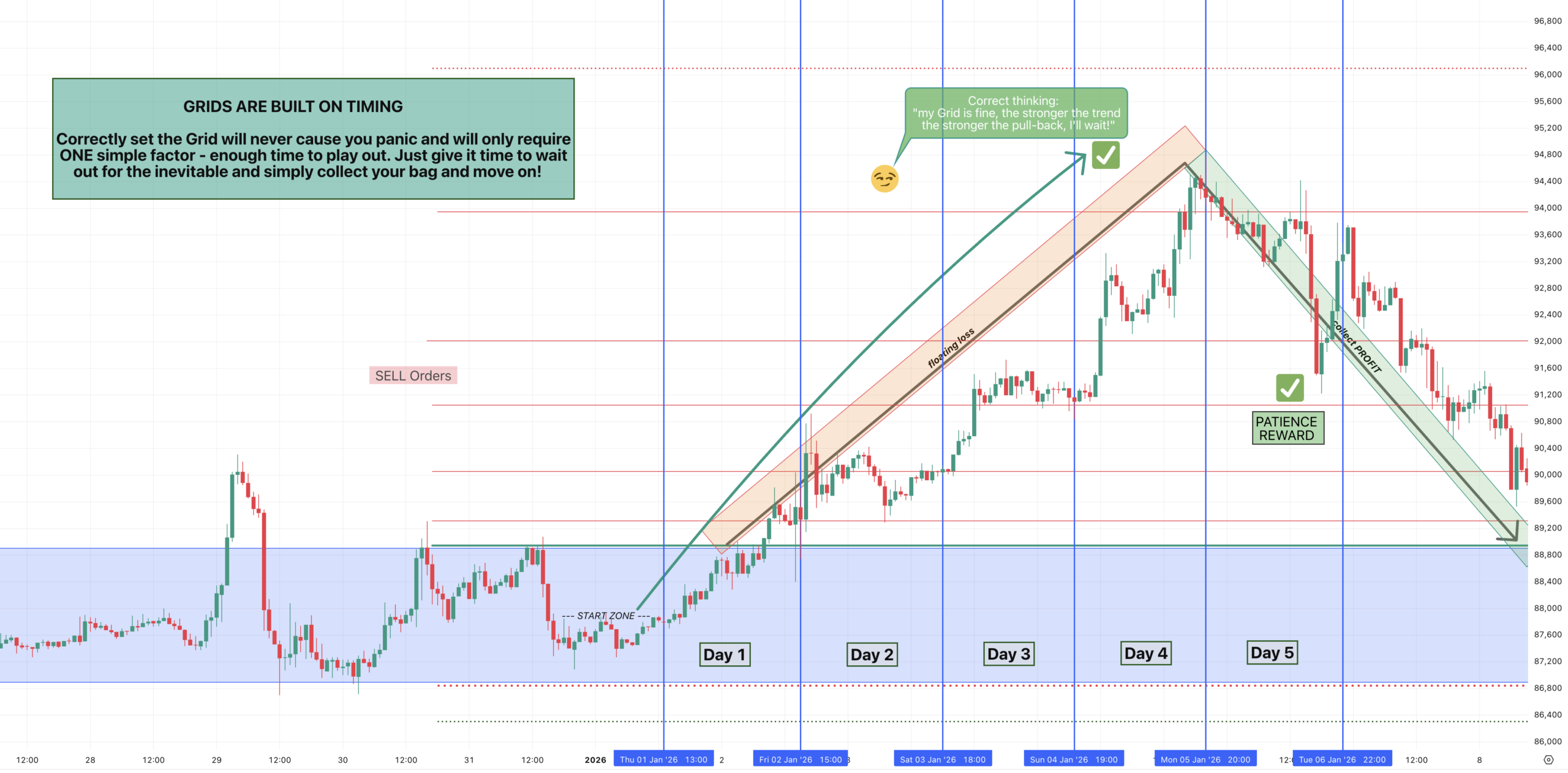
Time vs. Trend — Why Trends Cannot Defeat Correct Geometry
A trend is not an enemy of a grid. A trend is simply a time extension event.
The grid does not lose because the trend is strong. It loses because its solvable envelope is too shallow for the time the trend requires to complete its expansion.
Every grid has a maximum solvable excursion depth — a distance price can travel while the grid still remains mathematically recoverable. This distance is not random. It is defined by:
spacing geometry
lot growth behavior
margin buffers
floating loss curvature
retracement efficiency
capital size
broker leverage constraints
If the grid envelope is deep enough, time becomes an ally — not a threat. The grid simply waits. And when liquidity symmetry restoration begins, the entire exposure ladder resolves into profit.
Why “Fast Grids” Are Structurally Doomed
Fast grids use tight spacing, large lots, and aggressive compounding. They appear brilliant because they harvest many small retracements quickly. But they are structurally unsound because they sacrifice time survivability for trade frequency.
They do not give time space to operate.
When the first large expansion arrives – and it always does – the solvable envelope is exceeded before time can do its corrective work. The grid collapses even though the retracement would have occurred shortly after.
This is why most public grid bots die right before their recovery would have happened.
They don’t lose to price.
They lose to impatience.
Why Manual Intervention Kills Grids
Human traders are wired to stop pain, not to preserve solvability. When floating loss increases, emotional pressure rises. Traders interfere, reduce grid depth, close baskets early, tighten spacing, hedge incorrectly, or shut the system down entirely. Each of these actions destroys the recurrence geometry.
They interrupt the time cycle. They convert unfinished oscillations into permanent loss. Grid systems must not be “managed emotionally.” They must be engineered geometrically and left to let time work.
Why Grid Profit Is Inevitable Given Time
Grid profit does not rely on market correctness. It relies on market recurrence.
Markets do not move in straight lines. They oscillate. They must oscillate – because liquidity must rebalance. This is a physical property of exchange systems.
As long as the grid remains solvent:
every oscillation adds profit
every retracement resolves exposure
every completed cycle increases equity
time becomes cumulative profit energy
The grid becomes a profit engine – not a trading system.
Final Thoughts
Grid trading is not about entries.
It is not about indicators.
It is not about signals.
It is not about prediction.
Grid trading is about giving time a mathematically solvable structure to work inside.
When you do that, time becomes your trader. And time never loses.
Dynamic spacing is one of the hidden engineering layers that separates stable grid engines from disposable template bots.
It transforms grid trading from:
A fragile frequency game into
A controlled probabilistic profit engine
It remains solvable not only during calm markets – but during the very expansions that destroy most grids. And this is only one layer of grid geometry. Spacing protects exposure growth. Reverse Center(another safety feature) protects recovery geometry. When spacing alone is no longer enough, Reverse Center is what quietly saves accounts. That’s where the real magic lives.
Looking for a Reliable Automated Grid EA System?
Grid EA PRO is a mathematically engineered grid trading system that has been developed, tested, and refined over many years specifically to operate inside solvable volatility envelopes rather than chasing short-term trade frequency. Its internal logic continuously manages spacing expansion, floating loss curvature, retracement efficiency, margin buffers, and basket equilibrium in real time, forming a self-balancing probabilistic trading engine.
Instead of reacting to indicators or attempting to predict market direction, the system is built around structural market geometry – allowing it to adapt dynamically to price expansion, contraction, and retracement behavior.
If you are looking for a reliable long-term automated grid trading system based on mathematical solvability rather than directional guessing, you can review the full Grid EA PRO documentation and user manual here:
https://fxsharerobots.com/grid-ea/
It may be the final trading tool you were actually looking for – not because it predicts markets, but because it is engineered around how markets actually move.
👇 Read More! Important and Interesting Articles About Grid Trading Engineering:
Grid Trading System – Complete Grid Trading Guide
Grid Spacing Geometry – The Real Risk Control in Grid Trading
Reverse Center – The Recovery Geometry That Keeps Grid Systems Alive
Why Most Grid EAs Blow Accounts – The Hidden Mathematics of Exposure Collapse
Grid Trading Money Management – Why Cycles, Not Trades, Are the Real Profit Unit (VERY IMPORTANT!)