
Why Cheap Grid EAs Blow Accounts – The Hidden Mathematics of Exposure Collapse
Grid trading has gained a reputation for being “dangerous”, “unstable”, and “account-killing”. This reputation did not emerge because grid trading is structurally flawed. It emerged because the majority of grid systems in public circulation violate the mathematics that make grid trading solvable. What traders experience as “random grid failure” is not randomness at all – it is delayed structural collapse. The system was mathematically broken long before the chart made it visible.
Grid strategies do not fail because markets trend. They do not fail because volatility increases. They do not fail because news events occur. They fail because their internal exposure geometry quietly drifts outside the solvable envelope required to survive time. Most grid bots on the market are not trading systems – they are exposure generators whose failure is mathematically inevitable, only delayed by calm market phases.
This is why grid blow-ups feel sudden and unfair. The grid appears to “work beautifully” for weeks or months. Baskets close. Equity rises. Confidence builds. But the system’s internal geometry has already crossed a boundary where exposure expands faster than retracement can mathematically neutralize it. The collapse is not caused by the next trend – it is merely revealed by it.
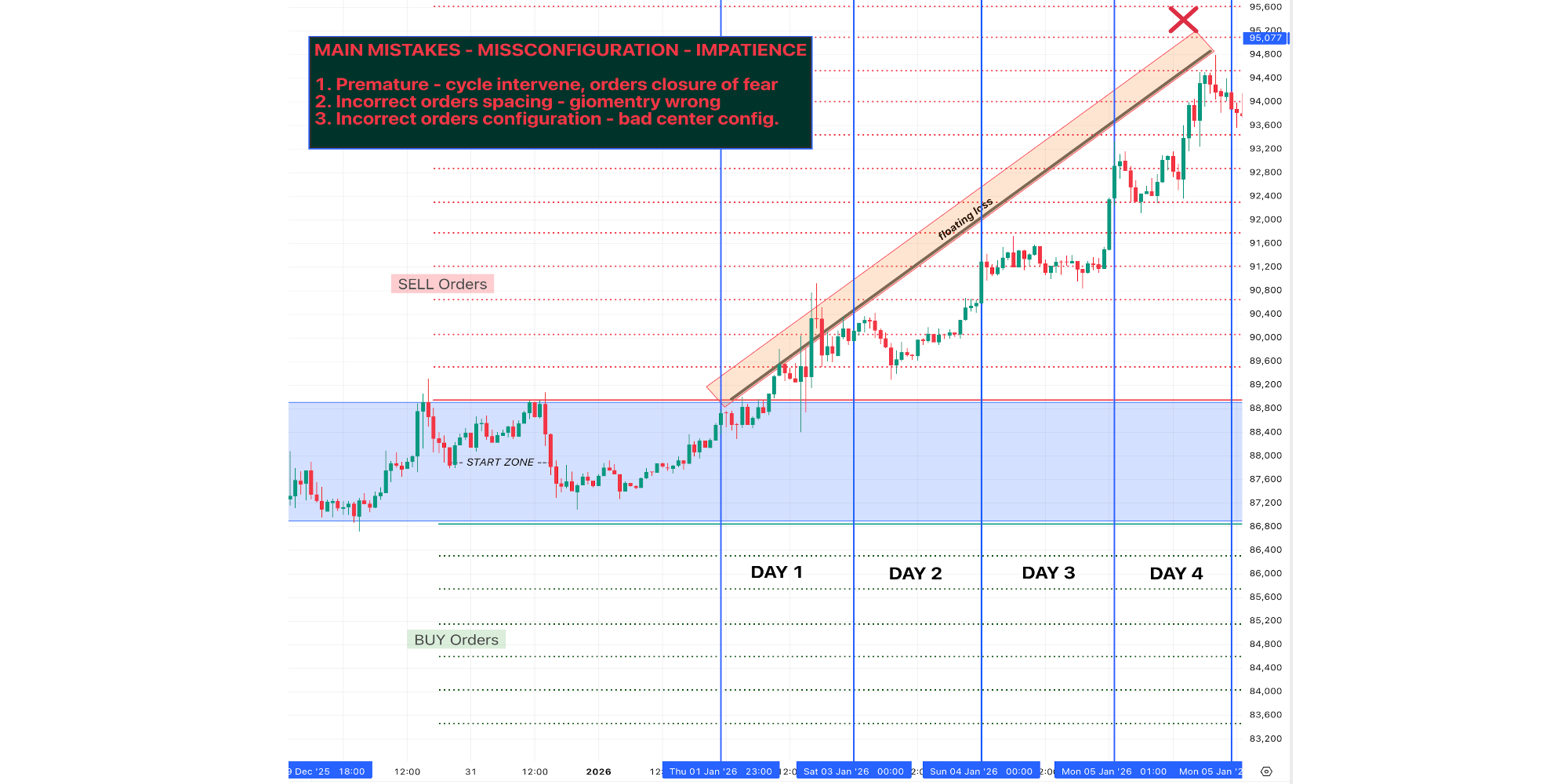
The Solvable Envelope – Where Grid Safety Actually Lives
Every grid operates inside a solvable envelope – a bounded region of exposure where floating loss can always be mathematically neutralized by future retracement cycles. Inside this envelope, time works for the grid. Outside of it, time works against the grid. Whether a grid survives has nothing to do with prediction accuracy and everything to do with whether its exposure geometry remains inside this envelope.
In simplified structural terms, grid profit is produced by completed retracement cycles over time:
Total Profit ≈ Σ(Retracement Cycles) – Carrying Costs – Slippage
Direction does not appear in this model. What matters is how many complete retracement cycles occur while the grid remains alive. This reframes grid risk entirely:
In trend trading, risk is “being wrong.”
In grid trading, risk is running out of survivable time.
The deeper price moves without retracing, the more exposure accumulates. But retracement profit only grows linearly, while floating loss grows geometrically because every open order contributes to the total loss surface simultaneously. Once the floating loss surface grows faster than retracement cycles can mathematically discharge it, solvability is lost – even if baskets still continue to close for a while.
At that moment, the grid is no longer a trading system. It is a delayed liquidation engine.
Exposure Geometry – Why Loss Grows Faster Than You Think
The hidden killer in grid systems is not drawdown – it is exposure curvature.
Total floating loss is not “how far price moved.”
It is the sum of how far price is from every open position at the same time:
Total Floating Loss ≈ Σ |Price – Entryᵢ| × Lotᵢ
This summation grows much faster than price itself when spacing is tight or sizing is aggressive. Each new order does not add one unit of risk – it expands the entire loss surface of the grid. Ten tightly spaced sell orders during an upward move do not create ten equal risks; they create a layered geometric pyramid where the deepest trades dominate total drawdown and margin consumption.
This is why grids that feel “stable” in shallow oscillations suddenly implode during moderate extensions. The internal loss curvature silently crossed its solvable envelope long before the chart showed danger.
The Frequency Trap – Why “High Profit Rate” Is Structurally Lethal
Most public grid bots advertise high trade frequency and fast basket closure. This looks attractive because it creates frequent realized profit. But high frequency is not a benefit – it is a structural risk amplifier.
Tighter spacing increases order density. Higher density increases exposure curvature. Higher curvature reduces solvable excursion depth. This means the grid becomes mathematically vulnerable to smaller and smaller directional extensions. The system becomes profitable faster, but it also becomes unsolvable faster.
High frequency grids are not “aggressive.” They are mathematically short-lived.
This is why so many grid bots die suddenly after long profitable periods:
They were never built to survive time. They were built to harvest shallow oscillations and die when volatility finally stretches.
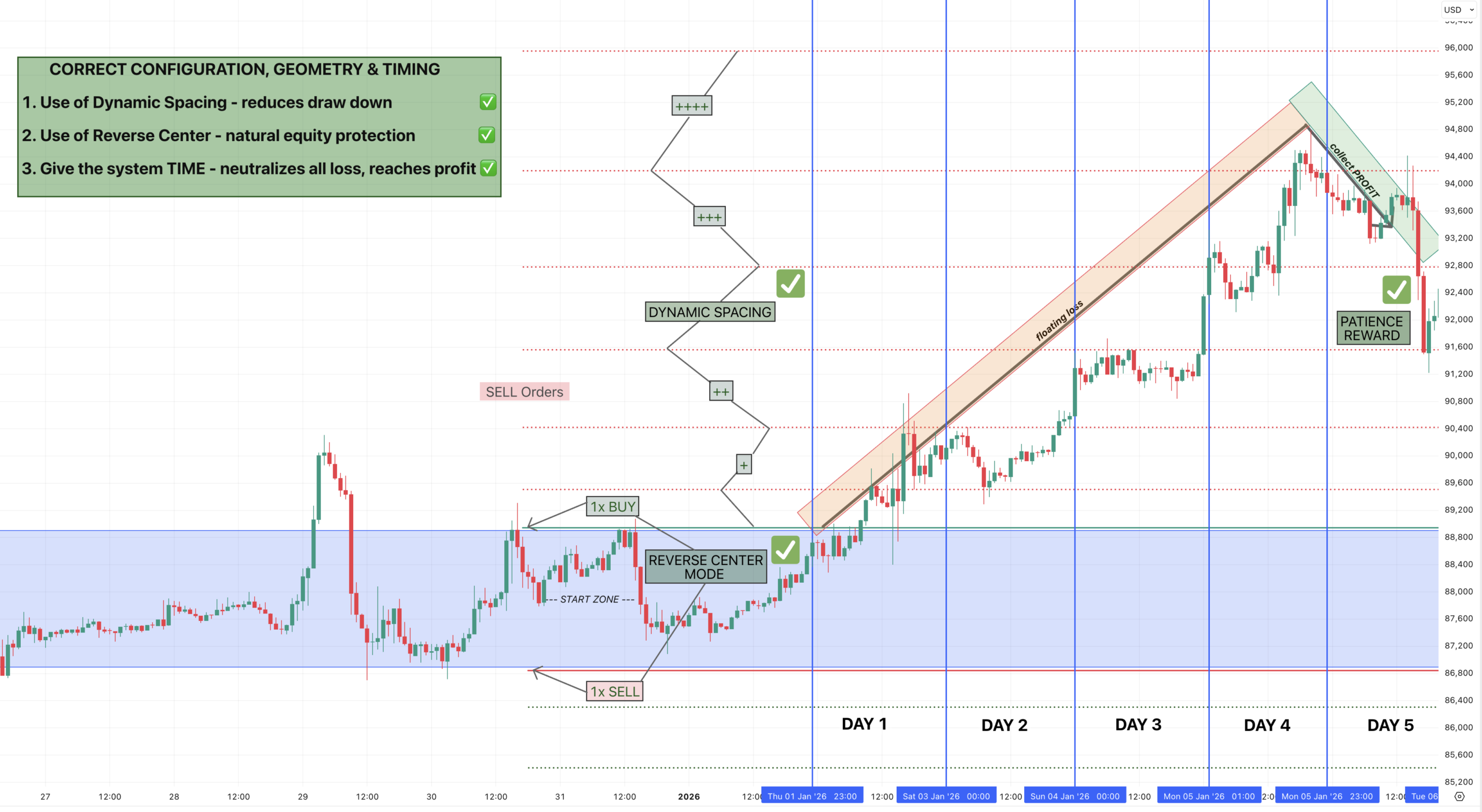
What This Means So Far
• Grid failure is not random — it is delayed structural collapse
• Exposure grows geometrically while retracement profit grows linearly
• Tight spacing and aggressive sizing shrink solvable time dramatically
• “Fast profit” grids are mathematically short-lived by design
Capital Buffer Geometry – Why Most Grids Die Even When Spacing Looks “Reasonable”
Spacing alone does not determine whether a grid can survive. Spacing defines how quickly exposure grows, but capital buffers define how far that exposure is allowed to grow before solvability is lost. This is the second layer most grid bots violate.
Every grid has a maximum survivable excursion depth – the furthest price can travel in one direction before retracement can no longer mathematically neutralize the accumulated floating loss. That depth is not psychological. It is geometric. It is a function of:
• spacing geometry
• lot growth geometry
• margin consumption
• floating loss curvature
• retracement efficiency
• account equity buffers
Once price travels beyond this envelope, the grid is mathematically dead even if it still appears to be operating.
Public grid bots rarely compute this envelope. They simply place trades until margin allows it – and margin is not a solvability metric. Margin only measures liquidation distance, not retracement recoverability. This is why grids can float in deep drawdown for long periods, still closing baskets, while their retracement solvability is already gone.
The collapse always arrives later – when price extends slightly further than “usual.”
Survivable Time – The True Resource of Grid Trading
Trend systems depend on accuracy. Grid systems depend on time survivability. The longer a grid remains alive, the more retracement cycles it can complete. And retracement cycles are the only source of grid profit. This is why survivable time is more important than win rate, profit factor, or frequency. If a grid can survive indefinitely, it will profit indefinitely.
If a grid can survive only a limited number of expansions, it is not a trading system – it is a timed detonation. This reframes grid safety entirely:
A grid that produces 0.3% per week for 10 years is infinitely safer than one that produces 6% per week for 3 months.
The market does not defeat grids. Time does – when geometry is wrong.
Human Intervention – The Invisible Failure Accelerator
Even grids that are mathematically correct are often destroyed by their operators.
When floating loss increases, traders panic. They close baskets early. They disable systems. They shrink grid depth. They “reduce risk” exactly when retracement solvability requires exposure to be allowed to complete its geometric cycle. This breaks the recurrence loop that produces profit.
Drawdown is not failure in grid trading.
Drawdown is the loading phase of the profit engine. Interrupting it converts a profitable geometric recurrence system into a losing random exit strategy. This is why manual grid trading almost always fails – not because the strategy is bad, but because humans cannot tolerate the necessary exposure phase that mathematically produces the profit.
Why Public Template Grids Are Guaranteed to Fail
Most grid bots in marketplaces share the same fatal traits:
• static tight spacing
• fixed lot growth
• no dynamic survivability envelope
• no retracement solvability model
• no capital buffer geometry
• no exposure curvature control
• no time survivability design
They are not misused. They are mis-engineered.
Their profitability is real — but temporary. Their collapse is not a surprise. It is mathematically guaranteed.
Final Thoughts - The Real Definition of a “Safe” Grid
A grid is safe when:
• its spacing expands with exposure
• its lot geometry is bounded
• its survivable excursion envelope is mathematically computed
• its retracement solvability remains intact under volatility
• its capital buffers scale with exposure curvature
• its recurrence loop is never manually interrupted
At that point, the grid is no longer a gambling structure. It becomes a controlled probabilistic engine that converts time into profit. And this is where real grid engineering begins.
Looking for a Reliable Automated Grid EA System?
Grid EA PRO is a mathematically engineered grid trading system that has been developed, tested, and refined over many years specifically to operate inside solvable volatility envelopes rather than chasing short-term trade frequency. Its internal logic continuously manages spacing expansion, floating loss curvature, retracement efficiency, margin buffers, and basket equilibrium in real time, forming a self-balancing probabilistic trading engine.
Instead of reacting to indicators or attempting to predict market direction, the system is built around structural market geometry – allowing it to adapt dynamically to price expansion, contraction, and retracement behavior.
If you are looking for a reliable long-term automated grid trading system based on mathematical solvability rather than directional guessing, you can review the full Grid EA PRO documentation and user manual here:
https://fxsharerobots.com/grid-ea/
It may be the final trading tool you were actually looking for – not because it predicts markets, but because it is engineered around how markets actually move.
👇 Read More! Important and Interesting Articles About Grid Trading Engineering:
Grid Trading System – Complete Grid Trading Guide
Grid Spacing Geometry – The Real Risk Control in Grid Trading
Reverse Center – The Recovery Geometry That Keeps Grid Systems Alive
Why TIME Is the Real Power Source of Grid Trading
Grid Trading Money Management – Why Cycles, Not Trades, Are the Real Profit Unit (VERY IMPORTANT!)