
Grid Trading System – Complete Grid Trading Guide
Grid trading is a popular trading strategy for any markets and all symbols based on placing buy and sell orders at fixed price intervals. In this guide, you’ll learn how grid trading works, its advantages, risks, and how grid trading EAs are used in automated trading. We have studied and worked with Grid systems for well over a decade now. It actually defines and fits our trading philosophy and model best because it is purely made of statistical mathematics and is mostly based on probabilities theory. That is our favorite topic, and that is how we design all trading systems – based on strict math, not on guesses. Our objective is to provide you with a comprehensive-scientific (yes this strategy is based on actual science) understanding of how this trading system operates, while highlighting its advantages and debunking myths. We will teach how any trader can set the market an inescapable trap, which, if done correctly, will inevitably lead to successful targets.
What Is Grid Trading?
Grid trading is a trading strategy which works on all types of markets. It is based on placing multiple buy and sell orders at fixed price intervals above and below the current market price. These orders form a “grid” on the chart, allowing traders to profit from price fluctuations without needing to predict the exact market direction.
Instead of relying on a single trade, grid trading works by opening a series of positions as the market moves. When price retraces, profitable trades are closed while new orders continue to build the grid. This approach allows traders to benefit from ranging and volatile market conditions where price frequently moves up and down. The system can also be reversed and adapted to work on more trending and less noisy markets. So it is very universal and adaptable to any instrument and various market conditions.
Grid trading can be used manually, but since it requires high precision and calculations today it is most commonly applied through automated trading systems known as Grid Trading EAs (Expert Advisors) on platforms such as MetaTrader 4.
How Grid Trading Works
Grid trading is not a single strategy — it is a framework. Inside that framework exist multiple grid models, each adapted to different market behaviors, volatility profiles and symbol characteristics. The core principle is simple: instead of predicting direction, grid trading profits from price movement itself.
Markets never move in straight lines. Even during strong trends, price constantly creates retracements, pullbacks, consolidations and micro-ranges. Grid systems are built to exploit these repeating price oscillations mathematically. A grid trading system constructs a structured network of price levels — a grid, where buy and sell orders are placed at predefined distances from a central reference price. As price moves, trades are triggered, profits are harvested from retracements, and the grid automatically rebuilds. But here is the critical part most guides never explain:
There are two fundamentally different grid philosophies:
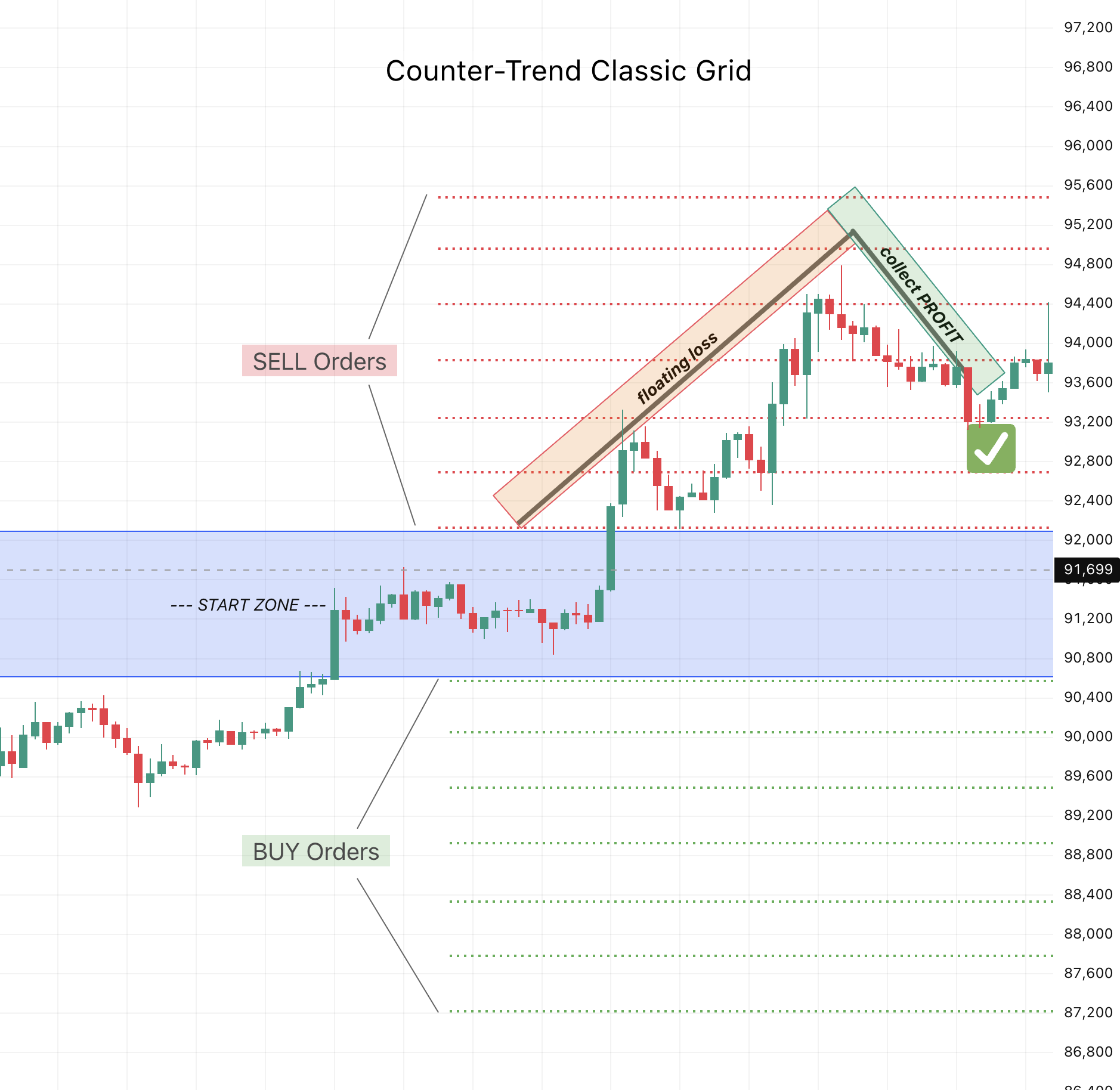
1️⃣ Counter-Trend Grid (Classic Grid)
This is the traditional and most widely used grid model. Orders are placed against price movement:
• Sell orders are layered above current price
• Buy orders are layered below current price
As price moves upward, sell orders are triggered.
When price retraces downward, those sells are closed in profit. When price moves downward, buy orders are triggered. When price retraces upward, those buys are closed in profit. This method works because markets naturally retrace. No trend continues forever — and even the strongest trends generate correction waves.
This model is extremely effective for:
• Ranging markets
• Sideways markets
• Volatile chaotic markets
• Symbols that frequently retrace (Gold, GBP pairs, Crypto, Indices)
It produces steady profit from oscillation rather than direction.
2️⃣ Trend-Following Grid
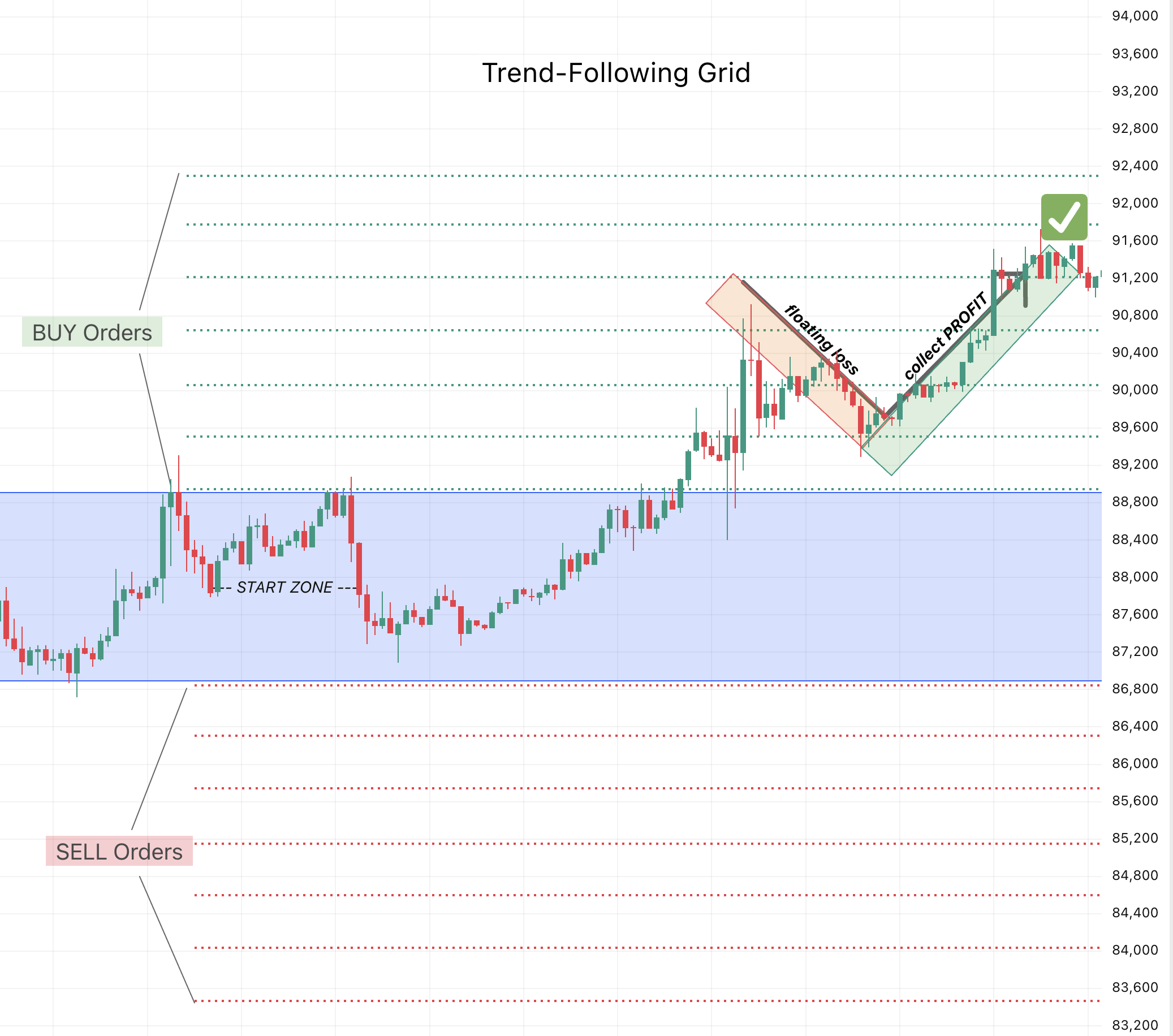
In this model, the grid is aligned with the market trend:
• Buy orders are layered in the direction of an uptrend
• Sell orders are layered in the direction of a downtrend
Here the grid compounds trend continuation instead of retracements. This model is ideal for:
• Strong trending symbols
• Smooth directional instruments
• Long-range momentum markets
Trend grids trade movement expansion instead of pullbacks. Modern professional grid systems allow switching between these two philosophies depending on symbol behavior.
Core Grid Structure
A complete grid trading system consists of:
• A central grid anchor price
• Dynamic or fixed spacing between levels
• Multiple pending buy and sell layers
• Automated rebuilding logic
• Profit target or equity target closure logic
• Risk balancing logic (hedging, spacing growth, reverse center, etc.)
Instead of managing trades manually, the grid mathematically controls trade sequencing, spacing expansion, risk balance and exit logic. This transforms trading into a controlled probability machine rather than emotional decision-making.
Why Grid Trading Works Long-Term
Price movement is not random chaos — it oscillates within probability ranges. Grid trading turns those oscillations into profit cycles. Rather than depending on one perfect entry, grid trading statistically forces profit to occur through repeated retracement harvesting. This is why properly engineered grid systems can remain profitable across: Forex, Crypto, Commodities, Indices, Stocks, Metals, etc..
What Is a Grid Trading EA?
A Grid Trading EA (Expert Advisor) is an automated trading engine designed to execute, manage and rebalance grid structures mathematically — without emotional bias and without manual intervention. Unlike classic trading systems that depend on predicting market direction, a grid EA is built to engineer profit from price oscillation itself. Instead of asking: “Where will price go?” A grid EA asks: “How can we mathematically extract profit from the fact that price must move, retrace, and rebalance over time?” It transforms chaotic market movement into a controlled probability machine.
What Makes a Grid EA Different from Normal Trading Robots?
Traditional trading robots are built around prediction. They rely on indicators, directional bias, fixed entries and exits, and the assumption that the market will behave in a stable, predictable way. Their entire structure depends on market regimes remaining compatible with their logic. When volatility changes, ranges appear, trends fail, or chaotic behavior emerges, most classical robots break down. They are reactive by nature – they wait for signals, then respond. But this also makes them structurally fragile to regime shifts and unpredictable market transitions.
Grid EAs operate on a completely different principle. They do not rely on directional prediction and they do not attempt to guess where the market will go. Instead, they operate on price geometry. They construct structured price envelopes around the market and adapt dynamically to movement rather than reacting to it. They are designed to function across trending, ranging and highly volatile market environments because they treat the market as a statistical system – not a guessing game. Where traditional robots depend on accuracy, grid systems depend on inevitability: the certainty that price oscillates, expands and contracts.
The Grid EA as a Market Engine
A true grid EA is not simply “placing trades.” It is continuously running a self-balancing probabilistic engine. At every moment, it manages spacing geometry, dynamic grid expansion, floating loss containment, profit harvesting cycles, equity balance symmetry, exposure distribution, recovery logic and exit sequencing. Every trade, every expansion step and every closure event is part of a coordinated system whose goal is to maintain equilibrium while extracting profit from price oscillation. This makes a grid EA fundamentally different from ordinary robots — it is not a signal executor; it is a market engine.
Why Grid EAs Exist
Manual grid trading is not “hard”. It is mathematically brutal. To run a grid manually, a trader would need to calculate – in real time all of the following:
• 15-30 price levels above and below current price
• Exact spacing between every level
• Different lot sizes per level (if using dynamic or progressive sizing)
• Floating loss at every possible future price
• Real profit after spreads, commissions and swaps
• Margin usage at every expansion step
• Break-even zones across multiple open orders
• Basket close points that guarantee net profit
• Recovery thresholds when price keeps moving without retracing
• Safe exit sequencing for 10+ simultaneous trades
Now imagine doing that while price is moving. Imagine recalculating everything every few seconds — while your account balance, margin and floating loss are constantly changing.
Then imagine manually closing 12–20 trades at the exact correct moment, in the correct sequence, without lag, without mistakes, without emotional hesitation. That is what manual grid trading actually requires. And that is why grid strategies evolved into automation long before most modern robots even existed.
Only automation can:
• Maintain perfect spacing geometry
• Balance floating loss dynamically
• Calculate real basket profit in real time
• Close dozens of trades at exact profit equilibrium
• Protect the account mathematically — not emotionally
A Grid EA does not replace the trader. It is the mathematical trader.
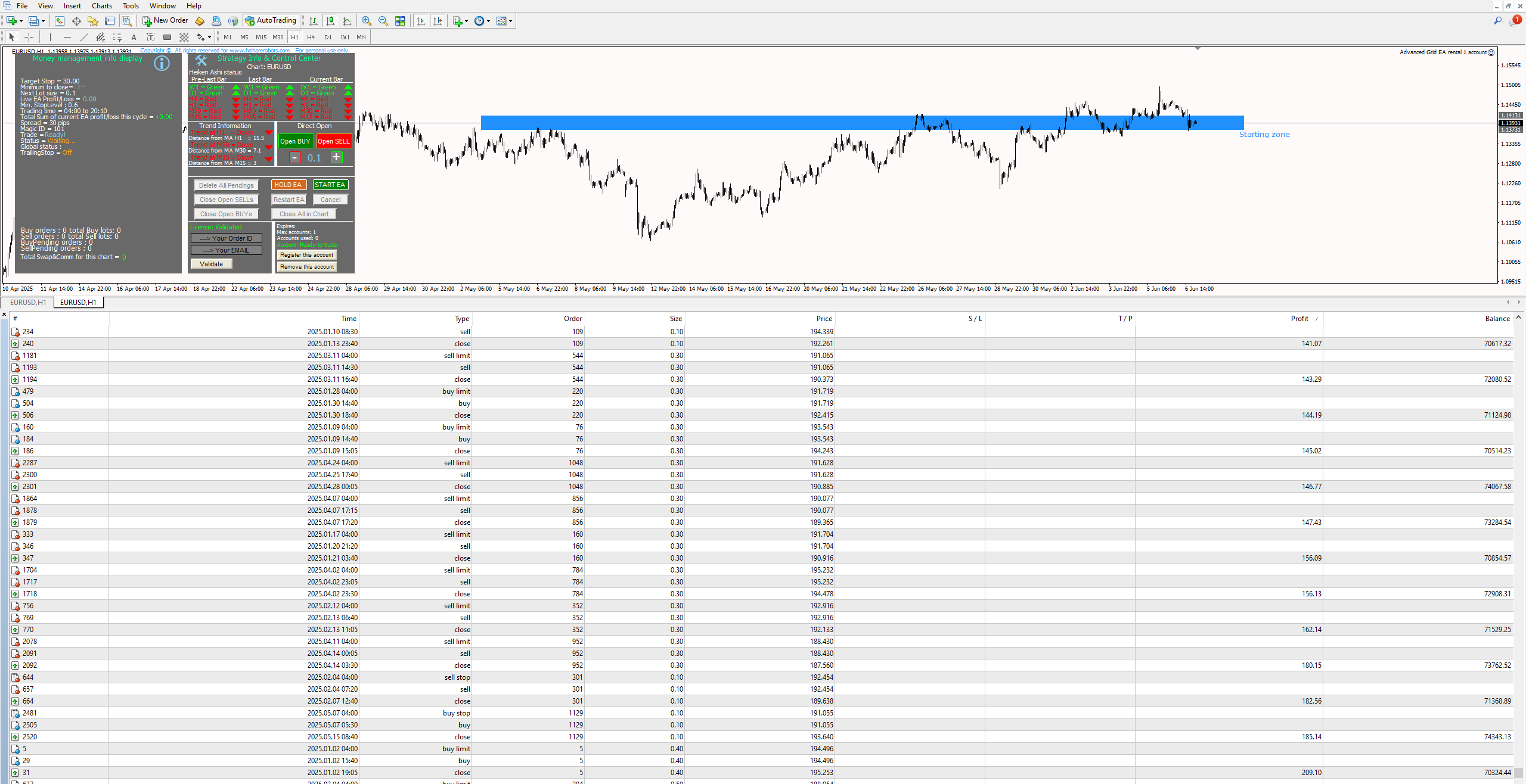
The Main Mathematics Behind – Why Manual Grid Fails
A grid is not just “placing orders”. A grid is a live probability machine that must continuously satisfy a set of mathematical conditions in order to remain profitable. At any moment, a running grid must satisfy:
Real Basket Profit Condition
Let:
• Pi = profit of each open order
• Ci = cost (spread + commission + swap)
• N = total open orders
Then real basket profit must satisfy:Σ(Pi − Ci) ≥ T for i = 1 … N
Where T is the required basket close target. This calculation must be recomputed on every tick.
Doing this manually in a live market is physically impossible.
Floating Loss Stability Constraint
Let:
• Lf = total floating loss
• Mf = free margin
• R = required safety ratio
Then:Lf ≤ Mf × RViolating this at any moment causes margin collapse. A Grid EA recalculates this continuously.
A human cannot.
Spacing Geometry Expansion Formula
Grid spacing must follow controlled expansion to prevent over-density:Dn = D0 + n × Δ
Where:
• Dn = distance of nth grid order
• Δ = expansion factor
• n = grid depth
This creates a non-linear density buffer protecting equity. Manual traders almost always violate this unintentionally — creating silent margin bombs.
Break-Even Probability Envelope
Expected retracement profit must satisfy:E(R) = Σ(pk × rk) > 0
Where:
• pk = probability of retracement
• rk = reward at each retrace level
Grid EAs dynamically harvest these envelopes. Humans cannot track probability envelopes in real time.
Sequential Exit Timing Constraint
Let:
• ti = close time of each order
• ε = acceptable slippage error
Then:|ti+1 − ti| ≤ ε
A human cannot close 15 orders inside this tolerance window. Automation can.
What This Means
This was just a few main Grid trading system formulas. If we add some advanced money management mechanisms or some other advance safety features, the calculation work load adds up very quickly. Manual grid trading is not “risky” – it is mathematically underpowered. It lacks the computational speed, precision and memory required to maintain a live probabilistic trading engine.
Automation is needed not because it is cool – Grid EAs exist because they are the only way grid trading can function correctly and safely.
Advantages of Grid Trading
Grid trading is not a prediction-based strategy. It is a market-structure exploitation model. Instead of attempting to answer the question “Where will price go?”, grid systems are designed around how price naturally behaves – and that behavior is universal: price oscillates. Every liquid market moves in expansion-contraction cycles. Even the strongest trends are not linear – they are composed of retracements, consolidations, volatility bursts and breathing phases. Grid trading converts this natural oscillatory behavior into repeatable profit cycles. It does not rely on directional correctness; it relies on the inevitability of price movement and the certainty that markets breathe.
Because of this, grid trading is direction-independent by design. Orders are distributed symmetrically above and below the current price in structured intervals, creating a mathematical profit envelope around the market. Profit is harvested when price retraces – or breaks through and cycles back – not when a directional prediction happens to be correct. This makes grid systems naturally resistant to false breakouts, sudden news spikes, stop-hunt movements and failed trends. In grid trading, it does not matter where price goes – only that it moves. From this logic emerges the most important resource in any grid system: time. Given time, grid systems do not depend on probability, they depend on inevitability.
Trend-following strategies require accuracy. Grid strategies require movement and patience. As long as the market has volatility and liquidity, grid trading can extract profit from oscillation. This is why grid systems perform exceptionally well in ranging markets, chaotic volatile environments, crypto markets, metals such as gold, and index markets – where price naturally expands, contracts, breathes and retraces continuously. Markets do not need to trend. They only need to move.
Where trend strategies produce binary outcomes – win or lose, grid strategies generate continuous profit cycling. They harvest dozens of smaller retracement profits that accumulate into smooth equity growth over time. This creates a naturally stabilized equity curve, significantly lowers psychological pressure, and produces consistent account expansion without dependency on a single perfect entry. Grid trading does not attempt to catch a move – it monetizes the market’s breathing process itself.
Another structural advantage of grid systems is natural capital scalability. Properly engineered grid systems scale proportionally with account size. Risk increases in relation to capital, not exponentially. This makes grid trading ideal for larger accounts, multi-pair portfolios, long-term capital growth and fully automated portfolio trading. Grid systems do not require increasing risk to increase returns – they require only correct spacing geometry and risk architecture plus time.
Grid trading is also inherently market-neutral. It does not depend on economic forecasts, news prediction, directional bias or trend assumptions. It depends only on liquidity, volatility and natural price oscillation – properties that exist in every liquid market. This is why grid systems remain effective across Forex, Crypto, Commodities, Indices, Metals and Stocks. The only requirement is that spacing logic, risk geometry and capital protection mechanisms are correctly engineered before applying the system to any symbol or market environment.
Risks of Grid Trading
Grid trading itself is not inherently dangerous. The real risk lies in misunderstanding the mathematics that govern how exposure, spacing, margin usage and retracement harvesting interact under real market dynamics. Most grid failures are not caused by “bad luck”, extreme volatility or unexpected news events. They are caused by structural misconfiguration – situations where the internal geometry of the grid becomes mathematically incompatible with the capital buffer supporting it. Another most common reason of Grid trading system failure is caused by human error – inpatience, the second biggest value after precision and calculus is to give the system enough time to breathe and play out the needed scenario. Because it is not the question if the final Target will be reached, it is – when!
Every grid system creates an expanding exposure surface as price moves away from its origin. Each additional order increases margin consumption, cost accumulation and drawdown sensitivity. If the spacing between orders remains static while exposure grows, order density compresses, and floating loss begins to expand faster than retracement profit can neutralize it. This condition creates what can be described as density collapse – a state where the grid becomes progressively harder to unwind even if price retraces normally. The system may still appear “alive”, but its internal equilibrium is already broken. From that moment, the grid is no longer harvesting oscillations – it is accumulating structural pressure.
Spacing geometry plays a critical role here. If grid depth increases linearly while margin pressure and cost accumulation grow non-linearly, the retracement efficiency of the system degrades silently. Each new level adds proportionally less closing power than the level before it, while simultaneously adding proportionally more drawdown stress. This imbalance produces expansion drift – a gradual migration of the grid toward mathematical instability. Most traders never detect this process because the account may continue to close baskets for weeks or months before the internal geometry finally fails.
Another fundamental risk is capital saturation. Every grid has a finite survivable excursion envelope – a maximum distance price can move before the capital buffer becomes structurally insufficient to support additional depth. Once this envelope is exceeded, no retracement – no matter how large – can mathematically return the basket to a profitable close. At this point the system enters a trapped state, where floating loss stabilizes into permanent drawdown. This is not a temporary drawdown problem. It is a structural lock. Without capital injection or forced liquidation, the system cannot recover, because the exit equations no longer have a solution.
Cost accumulation introduces a second hidden destabilizer. Spreads, swaps and commissions grow non-linearly as grid depth increases. If these costs are not explicitly modeled inside the basket close logic, profit targets slowly become false targets – values that are no longer reachable even during retracements that would previously have closed the grid in profit. This creates the illusion of “bad market conditions”, when in reality the system has simply drifted out of solvable territory.
Grid systems are not destroyed by volatility. They are destroyed by long directional extensions without sufficient corrective oscillation. A market that trends cleanly and persistently can exceed the survivable excursion envelope of any grid that has not been engineered with expansion geometry, reverse-center balancing and volatility-adaptive spacing (these are additional safety features; our Grid EA has them all). Without these mechanisms, the grid does not fail because price is “strong” – it fails because its internal geometry was never designed to handle that class of movement. In other words, each time a system is applied to a new instrument, it is mandatory to study its movement averages, check the nature of instrument volatility, does it tend to be more trendy in the end or remain chaotic in all time-frames? Given correct settings that define logical distances between the trades, evaluated capital, and adjusted money management settings accordingly – the risk of the system is minimal!
In short, grid trading does not fail randomly. It fails when the internal mathematics of exposure growth, spacing geometry, cost accumulation and capital buffering fall out of equilibrium. Properly engineered grid systems remain stable across markets and volatility regimes because they operate within mathematically bounded envelopes. Improperly engineered grids may appear profitable for long periods, but they are already structurally unstable long before the account finally collapses.
The Most Common Grid Failure Is Not Market Risk – It Is Time Risk
The majority of grid failures do not occur because the strategy “stops working”, but because the trader loses the only variable that grid systems absolutely require: time. Grid logic is mathematically designed around the certainty of retracement, not the prediction of direction. Every grid sequence is engineered to close at profit when the market breathes – not if it breathes. The market always does. What changes is the duration. Humans consistently destroy grid systems by intervening during the floating loss phase, closing baskets early, reducing grid depth, panicking during expansion, or shutting down the system right before the natural retracement cycle completes. In practice, this converts a mathematically profitable structure into a losing one by breaking its time symmetry. The strategy did not fail – the trader aborted the profit cycle. Grid trading therefore does not punish wrong direction. It punishes impatience. It requires the psychological capacity to allow drawdown to exist, because drawdown is not an error – it is the loading phase of the profit engine. Without time, grid has no mathematics. With time, grid has inevitability.
Grid Trading vs Martingale
Most people confuse grid trading with martingale because both strategies involve adding positions as price moves. On the surface they look similar, but internally they are fundamentally different systems with completely different mathematics, risk geometry and failure behavior.
Martingale is a loss-recovery mechanism. Its only purpose is to recover a previous loss by increasing position size in the same direction. Every new trade is directly chained to the failure of the previous one. This creates exponential exposure growth. Risk does not scale — it explodes. The entire system relies on the assumption that price must reverse before margin collapses. This means martingale does not manage probability – it bets against it. The longer the market moves without reversal, the closer the system gets to structural death.
Grid is not a loss-recovery strategy. It is an oscillation-harvesting engine. Each position exists as part of a geometric structure, not as a desperate attempt to fix a losing trade. Grid positions are distributed symmetrically around price, spacing expands according to geometry, profit is harvested from retracements, and exposure grows in bounded, engineered envelopes. Loss is not something that must be “recovered.” It is a controlled state inside the system, balanced by spacing, capital buffers, retracement probability and exit sequencing.
In martingale, risk grows exponentially with depth. In grid, risk grows according to engineered geometry. That single difference is what separates gambling logic from statistical logic. Martingale requires price to reverse soon. Grid only requires price to continue oscillating — which it always does in liquid markets.
Martingale collapses because exposure grows faster than margin can support. Grid collapses only when its geometry, spacing and capital buffers are incorrectly engineered. One fails by design. The other fails only by mis-engineering. Martingale is a bet against time. Grid is built on time.
This is why martingale systems eventually die in trending or runaway markets, while properly engineered grid systems remain stable across volatility regimes. Martingale trades direction. Grid trades structure.
Best Markets for Grid Trading
Grid trading is not limited to a specific asset class. It is not a “Forex strategy”, a “crypto trick”, or an “index pattern”. It is a structural model that exploits the universal behavior of liquid markets – oscillation, retracement and volatility waves. Because of this, grid trading is portable across markets, provided the system geometry is engineered for the volatility profile of the instrument being traded. The markets where grid systems perform best are not the markets that trend the most, but the markets that breathe the most. These are instruments that constantly expand and contract, creating frequent retracement waves rather than one-directional motion. In these environments, grid systems continuously harvest micro-oscillations, stacking profit cycles without needing directional accuracy.
- This is why grid trading performs exceptionally well in crypto markets. Cryptocurrencies are structurally chaotic, highly volatile, and dominated by liquidity sweeps, false breakouts and emotional extensions. They rarely move cleanly. They overshoot, retrace, stall, and reverse repeatedly – exactly the behavior grid systems are mathematically designed to monetize. Crypto does not reward prediction. It rewards oscillation harvesting.
- Gold and metals exhibit similar properties. They trend, but they trend violently and irregularly, constantly producing deep retracements and compression zones. This makes them ideal for grid structures with adaptive spacing and reverse-center balancing. These markets provide both volatility and liquidity – the two fundamental fuels grid systems require.
- Index markets also naturally support grid trading. Indices move as collective economic pressure systems rather than single instruments. They expand, compress, rotate, and retrace continuously as capital shifts between sectors. This creates long sequences of oscillation cycles that grid systems can harvest steadily over time.
- Forex pairs – especially major and cross pairs – remain effective grid environments because they are structurally range-biased, heavily mean-reverting, and constantly influenced by liquidity balancing between economies. They do not trend cleanly. They breathe.
The one environment where grid systems perform the worst is in structurally clean, low-volatility, single-direction instruments that trend slowly with minimal retracement. These environments starve the system of oscillation and delay profit cycling. But even this case could be solved by reversing the grids and turning it from oscilations profiting to trend profit based system. Grid does not fail on trending markets – but its efficiency degrades because the market stops breathing. In short: Grid systems do not need “good markets”. They need oscillating markets for classic counter trend setup or simply be reversed to adapt for trending markets. Wherever markets keeps expanding or oscillates more, grid systems can harvest profit.
Common Grid Trading Mistakes
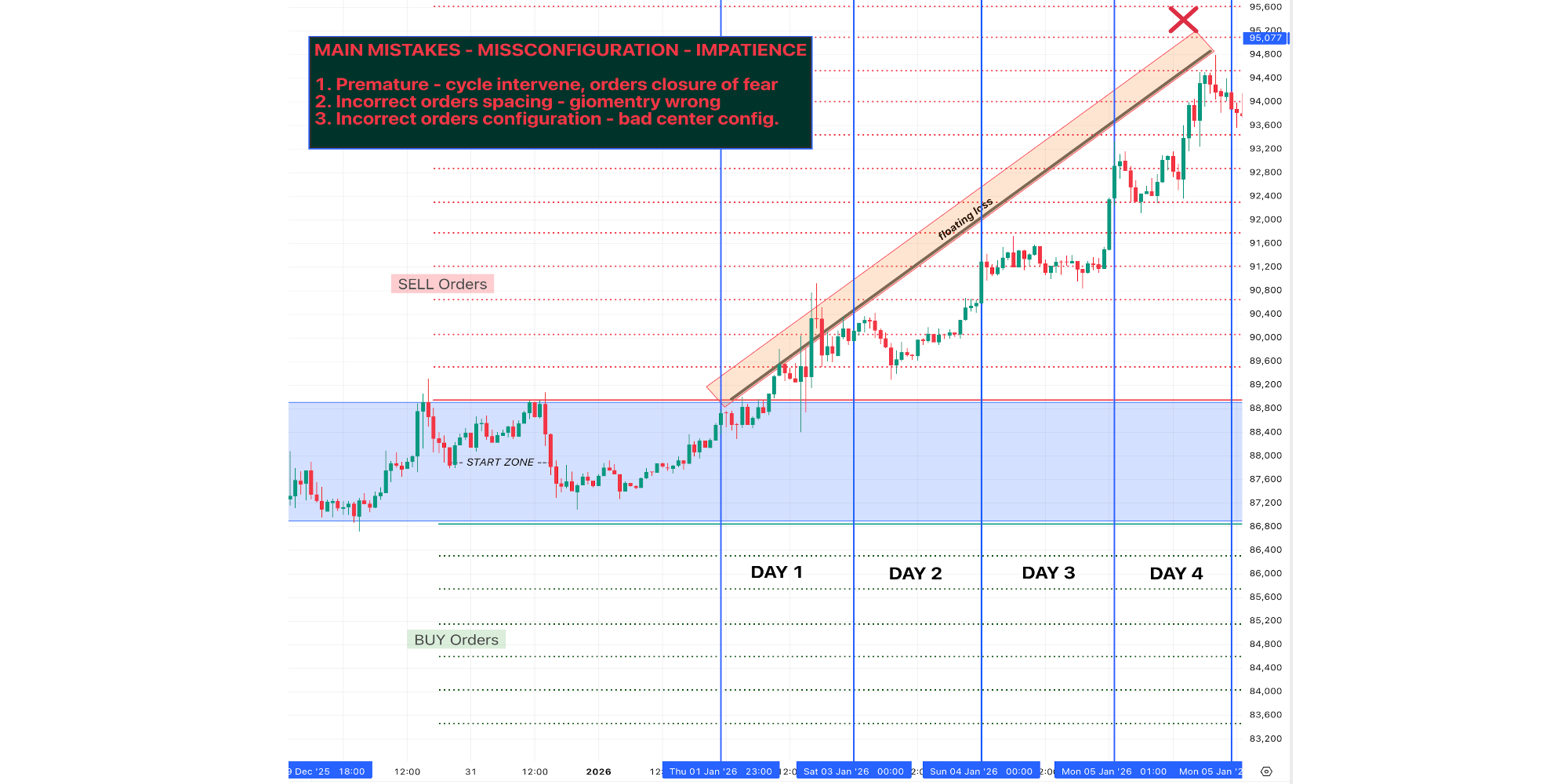
Most grid failures do not come from “bad markets”. They come from violating the internal geometry that makes a grid mathematically solvable. The strategy itself is structurally sound – but only inside its designed boundaries. Most traders unknowingly destroy those boundaries while believing they are “optimizing”. Now we will list you 5 main mistakes traders usually make when setting up their grids:
- The first and most fatal mistake is compressing spacing to increase profit frequency. When spacing is reduced below the volatility structure of the symbol, order density compresses faster than retracement profit can neutralize floating loss. The grid may appear more “active”, but internally its exposure geometry becomes unstable. Floating loss begins to grow non-linearly while retracement efficiency decays. This is the silent path to density collapse – the grid is still trading, still closing baskets, still “alive”, but its solvable geometry is already broken.
- The second mistake is increasing lot size without re-engineering capital buffers. Progressive sizing amplifies exposure geometry. If capital buffers are not expanded proportionally, the survivable excursion envelope shrinks rapidly. One clean directional wave then becomes mathematically unrecoverable even though the same grid appeared stable for months. This is why many grids “randomly die” – the death was engineered long before the chart showed it.
- The third mistake is copying settings between symbols. Volatility geometry is not transferable. What is safe on gold can be fatal on crypto. What is stable on EUR pairs can collapse on indices. When settings are copied, spacing and capital buffers no longer match the volatility envelope of the instrument. The grid becomes geometrically misaligned – it is no longer trading oscillation, it is trading instability.
- The fourth mistake is emotional intervention. Closing baskets early, reducing depth mid-cycle, manually intervening during floating loss, or disabling the system during expansion breaks the time geometry that grid trading requires. Grid logic assumes retracement certainty and requires time to complete its oscillation cycles. When time is removed, the engine is starved of the very condition that produces profit.
- The fifth mistake is misinterpreting drawdown as failure. In grid trading, drawdown is not an error – it is the loading phase of the profit engine. The grid must accumulate exposure before it can harvest oscillation profit. Traders who interrupt this phase collapse the profit cycle before it is mathematically allowed to complete.
Grid systems do not fail randomly.
They fail when their internal geometry is violated. Most “bad grids” are not bad strategies. They are mis-engineered probability engines.
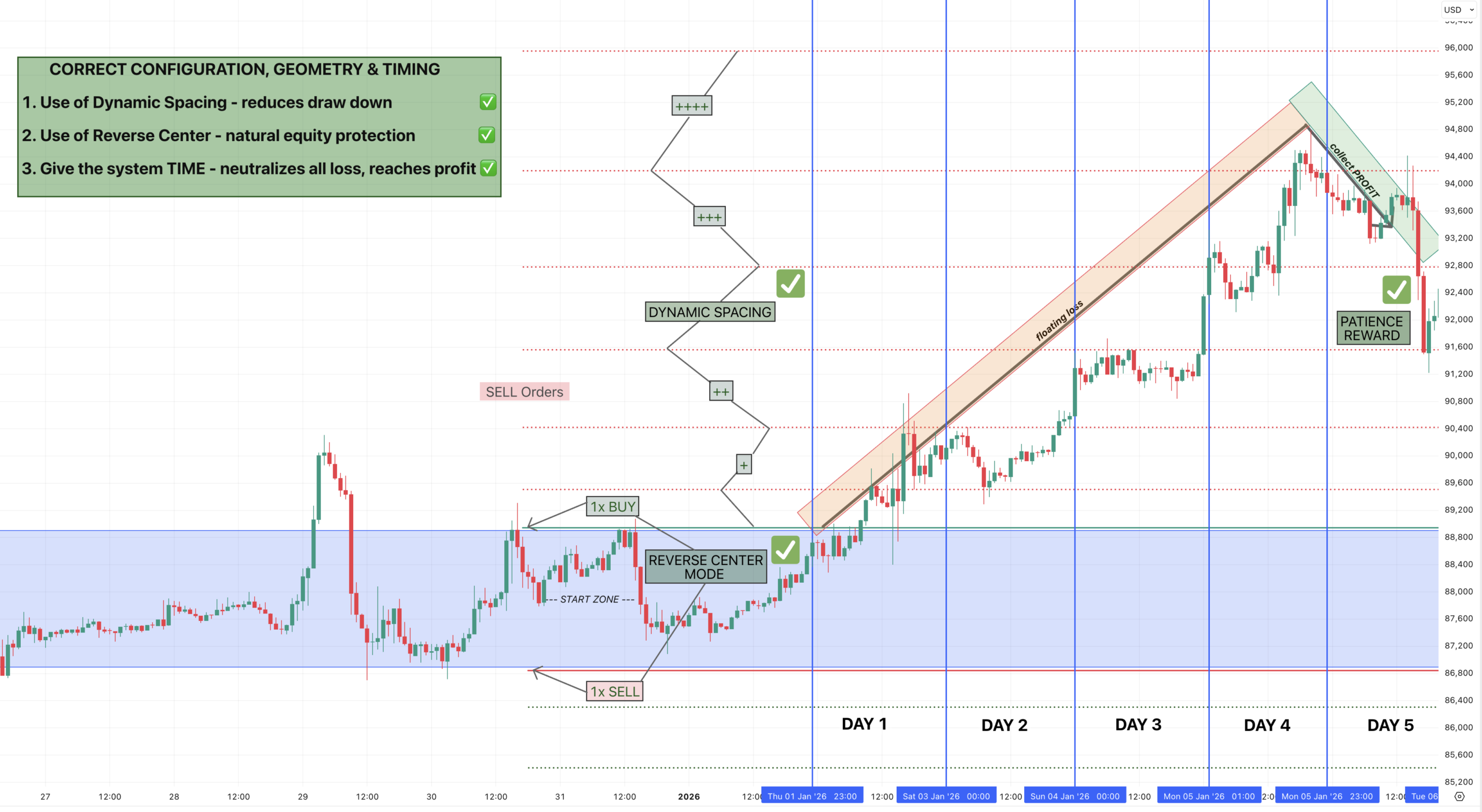
How to Use a Grid EA Safely
A grid system is not a plug-and-play toy. It is a geometric engine that must be tuned to the market it is applied to. While the logic of grid trading is universal, every symbol expresses volatility, retracement depth, expansion velocity and compression behavior differently. This means a grid cannot be safely deployed using a single universal template across all charts. Doing so silently destroys the internal geometry that makes the system stable in the first place.
Before a grid is ever activated, the instrument must be studied as a volatility structure — not as a “setup”. Each market has a characteristic breathing rhythm: how far it typically expands before retracing, how violently it spikes, how long it compresses, how quickly it rotates direction, how often it produces deep corrections, and how persistent its directional extensions are. Is there more trending or oscillation overall? Consider using a reversed strategy or not using this instrument at all. These characteristics define the mathematical boundaries within which a grid can operate safely.
Spacing distance is not cosmetic. It is the primary stabilizer of exposure geometry. If spacing is too tight for a symbol’s volatility, order density compresses faster than retracement profit can neutralize floating loss. This silently creates density collapse. If spacing is too wide, profit cycling efficiency degrades and the system starves. There is an optimal spacing envelope for every instrument – and it must be discovered through volatility structure analysis, not copied from another chart.
Lot sizing behaves the same way. Dynamic or progressive sizing must be engineered around margin geometry and worst-case expansion depth – not around profit desire. Risk must scale linearly with capital, not exponentially with exposure depth. Money management in grid trading is not “risk per trade”. It is structural exposure control across an expanding geometry.
Every symbol also has its own survivable excursion envelope – the maximum directional extension it can statistically reach before structural instability begins to emerge. Capital buffers must be sized so that the grid remains mathematically solvable inside this envelope. When capital buffers are incorrectly engineered, the grid may appear stable for months – and then suddenly lock permanently when a single directional wave exceeds its solvable geometry. This is why grid systems that appear “identical” behave completely differently across symbols. The grid is not trading price – it is trading the geometry of movement. And geometry changes from market to market.
A correctly engineered grid does not need to be protected by fear. It is protected by mathematics. It does not rely on stop losses, prediction, or emotional intervention. It remains stable because its spacing, capital buffers, expansion logic and exit equations were constructed to match the volatility structure of the instrument it trades. The most dangerous grid is not the aggressive one. It is the generic one.
Grid trading becomes safe when it becomes symbol-specific geometry – not a copied template.
Final Thoughts
Grid trading is not a shortcut, a trick, or a loophole in the market. It is a structural trading engine built on how price actually behaves – not how traders hope it behaves. Markets expand, compress, overshoot, retrace, and breathe in oscillation cycles. Grid systems do not attempt to predict these movements. They are engineered to harvest them.
When properly designed, a grid is not “taking trades”. It is running a probability engine that converts natural market motion into controlled profit cycles. Time is not an enemy to the grid – it is its fuel. Floating loss is not a mistake – it is the loading phase of the profit engine. Retracement is not luck – it is a structural certainty in liquid markets. This is why grid systems feel so different from conventional strategies. Trend systems try to be right. Grid systems are built to be inevitable. The market does not need to move in your direction. It only needs to move.
The true power of grid trading is not aggression. It is geometry. Spacing geometry. Exposure geometry. Capital buffer geometry. Exit sequencing geometry. When those structures are mathematically aligned to the volatility behavior of the instrument, the system becomes stable, scalable, and durable across time. This is also why grid trading cannot be reduced to a template, a preset, or a copied setup. Every symbol has its own volatility fingerprint, its own breathing rhythm, and its own survivable excursion envelope. A grid must be tuned to the geometry of the market it is applied to – otherwise it becomes misaligned and unstable, no matter how profitable it appears in the short term.
Grid EAs exist not to remove the trader – but to become the mathematical trader. They execute geometry, probability, sequencing, and capital balance at speeds and precision no human can replicate. They are not reacting to price – they are shaping exposure around it. And this is the core truth:
Grid trading is not dangerous. Poorly engineered grid trading is. When built correctly, a grid is one of the few strategies that does not rely on being right, on predicting direction, or on guessing outcomes. It relies only on what markets always do.
- They breathe.
- They oscillate.
- They retrace.
And that makes grid trading not just profitable — but mathematically inevitable.
Looking for a reliable automated Grid EA system?
Mathematics, statistics, and market structure are the foundation of our development philosophy. This is why our team has built deep expertise in grid trading and why Grid EA PRO has become our most popular automated system. Everything explained in this guide – spacing geometry, capital buffering, retracement harvesting, reverse engine, exposure control, and safety logic is already fully implemented inside Grid EA PRO. The system has been developed, tested, and refined over many years to operate as a stable, self-balancing probabilistic trading engine.
If you are exploring automated grid trading, you can review the full Grid EA PRO documentation and user manual here:
https://fxsharerobots.com/grid-ea/
The manual explains every parameter in detail and shows exactly how the system operates internally.
It may be the final tool you have been looking for a stable, fully automated grid trading engine built for long-term consistency rather than short-term speculation.
👇 Read More! Important and Interesting Articles About Grid Trading Engineering:
Grid Spacing Geometry – The Real Risk Control in Grid Trading
Reverse Center – The Recovery Geometry That Keeps Grid Systems Alive
Why TIME Is the Real Power Source of Grid Trading
Why Most Grid EAs Blow Accounts – The Hidden Mathematics of Exposure Collapse
Grid Trading Money Management – Why Cycles, Not Trades, Are the Real Profit Unit (VERY IMPORTANT!)